


Every AI research tool has the same problem: you can’t trust the citations. CoChat’s Citation Registry fixes that. It gives the AI a persistent, verified record of every source it finds, and it checks each one against CrossRef before you write a single sentence of your report.
TL;DR: Key Takeaways
Have you used ChatGPT, Claude, Gemini, or any “AI research assistant” for a literature review? Then here’s something worth knowing. Independent audits keep finding the same thing. These tools invent references outright. They get authors and DOIs wrong. They credit real papers with findings those papers never reported [1, 2].
Don’t assume a newer model fixes this. It doesn’t. A recent audit of ten currently deployed commercial LLMs put fabrication rates between 11.4% and 56.8%, and a newer model generation didn’t reliably lower them [2]. A separate benchmark tested thirteen state-of-the-art models, including GPT-5 and Claude-4. Every one hallucinated citations, at rates from 14% to as high as 95% [6]. The behavior rides along with capability. It doesn’t vanish when the version number goes up.
This isn’t a rare edge case. It’s the normal behavior.
CoChat’s Citation Registry is our structural answer. Rather than trust the model to remember its sources, we hand it a persistent, CrossRef-verified reference list that travels through every turn of the conversation. The AI can’t cite a source that isn’t on the list. It can’t misattribute a finding either, because the verified metadata sits in front of it the whole time it writes. This article walks through the problem in detail, explains why it happens deep in how these models work, and shows how we fixed it.
The Problem Nobody Talks About
Picture the workflow that sold you on AI research in the first place.
You ask an AI for a literature review on, say, retrieval-augmented generation in clinical decision support. It searches, it thinks, and within a minute it hands you fifteen papers in a tidy table: titles, authors, years, venues, DOIs. You spot-check a few of the DOIs. They resolve. The papers are real. You exhale.
Then you ask for the synthesis, the part that weaves those fifteen papers into a picture of what the field knows. Somewhere around paragraph nine, it starts making things up.
The papers are real. The claims aren’t.
Not the papers. Those still hold up. But the claims drift loose from reality. The methodology details stop matching the actual studies. A finding from one paper lands on another. Then a precise-sounding statistic (“a 23% improvement in diagnostic accuracy”) shows up attached to a real citation, yet appears nowhere in the source it points to. The sentence reads beautifully. It’s also fiction.
This part never makes the demo video. The AI finds correct papers, verifies their metadata, builds a clean table, and then hallucinates the analysis. It cites real papers with invented claims. Findings land on the wrong study. Plausible-sounding numbers appear from nowhere, because plausibility is exactly what these models optimize for.
Have you ever finished an AI-generated research summary and felt you had to re-read every sentence against the original PDFs before trusting it? Then you already know this problem in your gut. What you might not know: researchers have measured the rate repeatedly, and the numbers run worse than most people assume.
This isn’t anecdotal. It’s been measured.
Most people file “AI makes up citations” as an occasional glitch that hits other people who wrote a lazy prompt. The research disagrees. And it disagrees across every model generation, from GPT-3.5 in 2023 to the frontier models shipping today.
The first hard numbers
Start with the early benchmark that first put hard numbers on it. A 2023 study in Scientific Reports prompted the leading models of the day, GPT-3.5 and GPT-4, to write short literature reviews on 42 topics. The authors then checked all 636 references against multiple databases [1]. More than half of the GPT-3.5 citations matched no real work. Even among references that did point to real papers, many carried the wrong authors, titles, dates, or page numbers [1]. GPT-4 did better, yet still invented nearly one in five references outright [1].
It varies by discipline
The problem also shifts by discipline. A cross-disciplinary study in the Journal of Medical Internet Research had ChatGPT write manuscript introductions with citations, then checked every one. Only 72.7% of the natural-science citations and 76.6% of the humanities citations turned out to be real papers, and in the humanities a striking 89.4% of the DOIs were hallucinated [3].
Medicine is the worst case
Medicine has been a sobering test bed. A study titled Learning to Fake It asked ChatGPT twenty medical questions and requested supporting references. It produced 59. It fabricated 41 of them, roughly 69%, and the authors flagged how convincing the fakes looked: it paired real researchers’ names with plausible titles in credible journal formats [5]. A separate comparison in the Journal of Medical Internet Research tested ChatGPT and Bard (now Gemini) against gold-standard human systematic reviews. It clocked hallucination rates of 39.6% for GPT-3.5, 28.6% for GPT-4, and 91.4% for Bard [4]. The authors put it bluntly: don’t use these tools as the primary instrument for a systematic review, and treat every reference they generate as something a human still needs to validate [4].
Newer models don’t fix it
Now for the part that matters if you want to wave this off as an old-model problem. The newest and largest audits show it hasn’t gone away. One cross-model study generated 69,557 citation instances across ten deployed LLMs and four academic domains. Hallucination rates spanned a fivefold range, from 11.4% to 56.8%, shifting with the model, the field, and even how someone framed the prompt [2]. That same audit found no reliable improvement from newer model generations; an upgrade guarantees nothing [2]. A parallel benchmark tested thirteen state-of-the-art models, including GPT-5 and Claude-4, and caught every one hallucinating citations, at rates from 14% to as high as 95% [6].
Why this is so much worse than a normal “AI mistake”
Most AI errors announce themselves. Ask for code and it won’t compile; you find out right away. Request a summary and it reads thin; you can feel it. A fabricated citation is a different animal, because it hides on purpose. The fake reference looks perfectly formatted. It names a real author who genuinely publishes in the area. The journal exists. The title matches exactly what a paper on that topic would be called. As the medical-question study noted, the fabrications look real and hide almost perfectly unless you check each one [5].
That invisibility does real damage in research. A hallucinated citation doesn’t just cost you a few minutes. It works its way into a thesis chapter, survives into a submitted manuscript, and blows up during peer review or, worse, after publication. The system that should catch it leaks badly. In a survey of 97 researchers, 76.7% of reviewers admitted they don’t check references thoroughly, and 41.5% of authors admitted to pasting BibTeX entries without verifying them [6]. The same work documented an 80.9% jump in invalid citations across published AI/ML and security papers in 2025 [6]. These errors don’t stay in draft folders. They reach the permanent record.
Adoption, meanwhile, is outrunning caution. That same survey found 87.2% of researchers already using AI tools in their workflow [6], and a separate BMJ Mental Health survey of 714 mental health researchers found 69.5% use large language models to assist their work, 94% of them ChatGPT [7]. The tools are everywhere. Trust runs high. Verification habits haven’t caught up. The Citation Registry exists to close that gap.
Why AI Loses Track of Its Own Sources
Fixing the problem means understanding the mechanism, and the mechanism turns out more mundane, and more fixable, than “the AI is unreliable.”
Where the sources go
When a language model writes a long research report, everything it can “see” at any moment lives in a context window: a finite span of text holding your instructions, the conversation so far, the search results, and the report in progress. Early on, the model searched databases, pulled real papers, and verified DOIs, all of it sitting right in front of it. But the window has a hard size limit, and a thorough research conversation piles up a huge amount of text.
By paragraph twelve of a synthesis, the raw source data from the start has often slipped to the edges of that window, or dropped out of active attention entirely. The precise link between this finding and that DOI is exactly the fine-grained detail that decays first.
The AI isn’t lying. It’s forgetting.
So the model does what its training rewards: it predicts the most plausible next words. It recalls the shape of what it found, roughly which topics the papers covered and what they suggested. The exact wiring, though (who reported what, which DOI attaches to which claim, what the sample size actually was) has blurred. Asked for a citation it can no longer see, the model doesn’t stop and admit the gap. It generates a citation-shaped string that fits: a real author, a believable title, a well-formed DOI. The result looks statistically excellent and reads factually empty.
The AI isn’t lying. It’s forgetting, then confidently papering over the gap.
That reframes the whole problem. The failure isn’t dishonesty or incapacity. It’s architectural. We asked the model to hold a set of precise facts steady across thousands of words, and that’s exactly what the architecture handles badly. The audit data backs this reading. One large study found that no model fabricates citations on its own when nobody asks it to produce them, which marks the behavior as something the task triggers under memory pressure rather than an innate urge to lie [2]. The same study showed two fixes that work: ask several models and keep only the citations they agree on (accuracy climbs to 95.6%), or repeat a prompt and keep the consistent answers (88.9%) [2]. Stop leaning on one fragile memory, add an external check, and the problem largely dissolves.
That idea, don’t trust the memory and add an external check, drives the entire design of the Citation Registry.
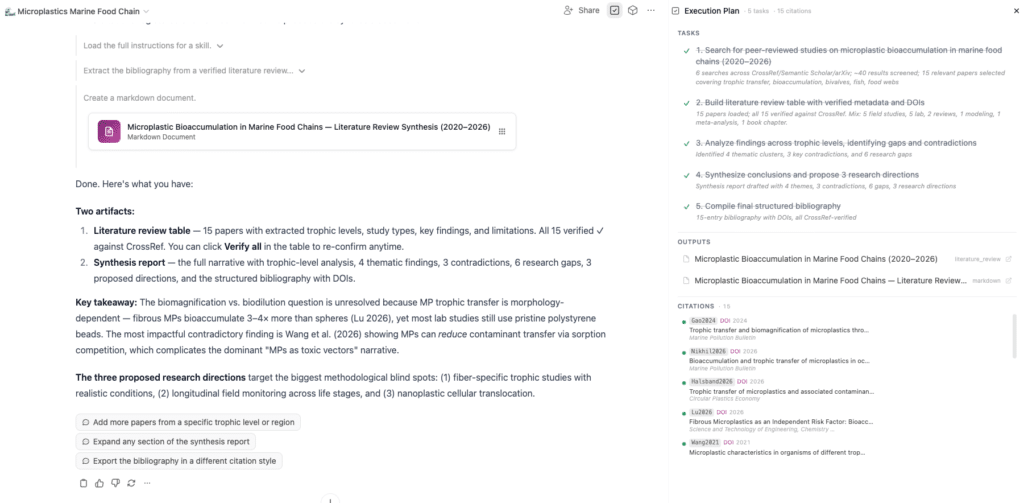
How the Citation Registry Works
CoChat’s Citation Registry takes a different route. Instead of hoping the AI remembers its sources, we hand it a persistent, verified reference list it can’t forget. The list re-enters the model’s context on every single turn, and every entry clears an authoritative external database before the model may lean on it.
Here’s how it works, step by step.
1. Every source gets registered the moment the AI finds it
The AI doesn’t just mention a source and move on. It registers each one in the Citation Registry: a structured metadata object holding the title, authors, year, venue, DOI, and a verification status. This isn’t a note buried in the chat transcript that scrolls away. It’s a distinct piece of structured state that lives with the conversation itself.
2. The registry re-enters every turn as persistent context
This is the core move. The registry never sinks into the fading middle of the chat history. It re-enters the model’s context on every turn, in its own dedicated block, the same way CoChat’s task plans stay present so the agent always tracks what’s done and what’s left.
The key point deserves plain language, because it’s the whole thing: the AI doesn’t need to remember its sources, because the sources never leave. When the AI writes a synthesis report, it isn’t rebuilding citations from a decaying memory of what it read twenty paragraphs ago. It reads them off a live, verified list sitting right there in its context as it writes each citation. The failure mode from the last section, where the link between claim and source blurs as the window fills, simply can’t happen, because the system restates that link in full on every turn.
3. Every DOI clears CrossRef before it counts
Persistence alone isn’t enough. A remembered wrong citation is still wrong. So the registry adds verification underneath. When a source carries a DOI, CoChat checks it against CrossRef, the official DOI registration agency for scholarly literature. A resolving DOI with matching metadata earns a verified mark. The registry flags a DOI that doesn’t match, or can’t be found at all, visibly, before you write the report rather than after you submit it.
The strongest academic audits recommend exactly this: resolve every citation against an authoritative index such as CrossRef, OpenAlex, or Semantic Scholar rather than trusting the generator [2, 6]. We built that step into the workflow, so it runs automatically, on every source, every time.
4. The AI stays constrained to the registry
Because the verified list stays present, two hard constraints hold. The AI can’t cite a source that isn’t on the list, so no shadow set of half-remembered references creeps in. And it can’t misattribute a finding, because the correct metadata sits in context at the exact moment it writes the sentence. Nobody asks the model to be more honest or to try harder. The setup simply closes off the fabrication shortcut and makes the correct path the easy one.
The pattern, in one line
This mirrors the principle that makes CoChat’s task execution reliable: don’t ask the model to remember critical state, hand it that state persistently and verify it externally. Task plans stay in context as durable state, so the agent always knows the plan. Citations now work the same way. They aren’t chat history that scrolls into oblivion. They’re structured, verified state that lasts the life of the conversation.
flowchart TD
    A[AI searches 7 databases] --> B[Paper found]
    B --> C[Registered in Citation Registry:\ntitle, authors, year, venue, DOI]
    C --> D{DOI present?}
    D -->|Yes| E[Checked against CrossRef]
    D -->|No| F[Flagged: unverified]
    E -->|Match| G[Marked verified ✓]
    E -->|No match| H[Flagged ⚠ — fix before citing]
    G --> I[Registry re-injected into EVERY turn]
    F --> I
    H --> I
    I --> J[AI writes synthesis reading from\nlive verified list — not memory]
    J --> K[Every citation traces to a\nverified registry entry]
What This Means for Your Research
The architecture is the how. Here’s the what — what actually changes when you do research inside CoChat.
No more phantom citations
CrossRef has already checked every source in your literature review, the same check that powers our AI citation checker. A DOI that doesn’t match its metadata surfaces before you write the synthesis, long before the work reaches a committee or a reviewer. That fabricated reference the audits caught at rates between 11% and 95% across models [2, 6], the one that looks perfect and points to nothing, is the exact thing the registry keeps out of your output.
Accurate attribution
Say the AI writes “Smith et al. (2024) found a 23% improvement in response time.” That claim traces straight back to a verified registry entry whose metadata sat in context as the sentence formed. It rebuilds nothing from a fading memory of what Smith’s paper probably said; it anchors to a record the system already checked. This targets the subtler failure, the one even harder to catch than a fake DOI: the model crediting a real paper with a finding it never reported [1, 5].
Verified literature review tables
CoChat’s literature review tables already organize sources with DOIs, authors, venues, and your own custom extraction columns, plus relevance ratings and one-click CSV/XLSX export. The Citation Registry adds a verification layer underneath: every row maps to a registered, CrossRef-checked citation that the AI references consistently throughout the conversation. The table you build and the report you generate draw on one verified source of truth, so they can’t drift apart.
A transparent, checkable trail
An explicit verification status makes the whole sourcing process legible. You, your advisor, your reviewer, or your students can see which sources the AI found, which ones passed, which ones got flagged, and how each one shows up in the final output. “Trust me, the AI found it” becomes “here’s the verified registry, check any entry you like.”
The Full Research Stack, Connected
The Citation Registry isn’t a standalone gadget. It’s the layer that ties together everything CoChat already does for research:
- Seven academic databases, searched at once: arXiv, PubMed, Semantic Scholar, OpenAlex, CrossRef, CORE, and Europe PMC. You don’t query one index with its own blind spots. You sweep the major scholarly databases together.
- Literature review tables with custom extraction columns, relevance ratings, and CSV/XLSX export, so the organizing happens where the finding does.
- Full-text access via CORE, so the AI extracts from the actual body of open-access papers instead of guessing from an abstract. Abstract-only reasoning drives a lot of misattribution.
- Flashcards generated from your review, so the sources you verified become the material you study.
The registry sits underneath all of it. It tracks every source you find across those seven databases, organizes it in your table, feeds it to your flashcards, and cites it consistently in your synthesis, from the first search to the final paragraph.
Who This Is For
Graduate students
Your committee expects rigorous citations, and “the AI made it up” won’t survive a viva. The audit literature is direct about the stakes for systematic reviews: current models shouldn’t be the primary tool, and every reference they produce needs validation [4]. The Citation Registry builds that validation in. CrossRef verifies every source in your AI-assisted review, so your committee can check any citation and land on exactly the source you meant. If you’re still assembling your toolkit, start with AI study tools that actually work, not ones that invent sources.
Researchers
You’re mapping a field and need speed without giving up accuracy. You also know the published record already absorbs fabricated citations at a growing rate [6]. Search seven databases, organize a review table, generate a synthesis, and trust that every citation resolves to a real, verified source. That’s the promise of AI for academic research: the registry keeps the speed that made AI research appealing and drops the fabrication rate that made it risky.
Educators
You build reading lists, model research methods, or teach students to evaluate sources in an AI-saturated world. The Citation Registry makes the sourcing process transparent: students see which sources the AI found, how CrossRef verified them, and how each one shows up in the final output. It turns “don’t trust AI citations” from a warning you repeat into a workflow you can show, and a verification habit you can hand them.
A Note on Honesty
We could have written this article without admitting that CoChat had the same problem until recently. We didn’t, because the whole feature rests on honesty about sources, and launching it on spin would feel strange.
So, plainly: the fabrication-during-synthesis failure at the top of this article described CoChat too, until we shipped the Citation Registry. The AI found correct papers, verified their metadata, built a clean table, and could still drift once it wrote the long-form analysis, for exactly the architectural reasons above. We didn’t fix it by telling the model to try harder, because the audits make clear that pep talks don’t work [2]. We changed the architecture instead, so the verified sources stay present and get an external check. That’s a structural guarantee, not a personality adjustment, and that’s why we’re comfortable putting our name on it.
Try It Now
The Citation Registry is live in every CoChat research conversation. Nothing to set up, nothing to toggle. It activates the moment your research touches academic citations.
- Start a free conversation at app.cochat.ai
- Ask any research question
- Watch the AI find, register, and verify sources against CrossRef in real time
- Request a synthesis report and see every citation backed by registry-verified metadata
Your citations should be as trustworthy as your research. Now they are.
Sources
- Walters, W. H., & Wilder, E. I. (2023). Fabrication and errors in the bibliographic citations generated by ChatGPT. Scientific Reports. https://doi.org/10.1038/s41598-023-41032-5
- Naser, M. Z. (2026). How LLMs Cite and Why It Matters: A Cross-Model Audit of Reference Fabrication in AI-Assisted Academic Writing. arXiv (preprint). https://doi.org/10.48550/arXiv.2603.03299
- Mugaanyi, J., Cai, L., Cheng, S., Lu, C., & Huang, J. (2023). Evaluation of Large Language Model Performance and Reliability for Citations and References in Scholarly Writing: Cross-Disciplinary Study. Journal of Medical Internet Research. https://doi.org/10.2196/52935
- Chelli, M., Descamps, J., Lavoué, V., Trojani, C., Azar, M., Deckert, M., Raynier, J.-L., Clowez, G., Boileau, P., & Ruetsch-Chelli, C. (2024). Hallucination Rates and Reference Accuracy of ChatGPT and Bard for Systematic Reviews: Comparative Analysis. Journal of Medical Internet Research. https://doi.org/10.2196/53164
- Gravel, J., D’Amours-Gravel, M., & Osmanlliu, E. (2023). Learning to Fake It: Limited Responses and Fabricated References Provided by ChatGPT for Medical Questions. Mayo Clinic Proceedings: Digital Health. https://doi.org/10.1016/j.mcpdig.2023.05.004
- Xu, et al. (2026). GhostCite: A Large-Scale Analysis of Citation Validity in the Age of Large Language Models. arXiv (preprint). https://arxiv.org/abs/2602.06718
- Role of large language models in mental health research: an international survey of researchers’ practices and perspectives. (2025). BMJ Mental Health, 28(1), e301787. https://mentalhealth.bmj.com/content/28/1/e301787
Related reading:
5 Ways AI for Academic Research Is Transforming How You Study ·
CoChat Now Searches 7 Academic Databases ·
Literature Review Template: How to Organize, Verify, and Export Your Research (Free)
