A step-by-step literature review template with a real example — plus how to verify every citation automatically.
Writing a literature review shouldn’t mean drowning in spreadsheets, losing track of sources, and hoping you didn’t misquote a paper. But that’s exactly what happens when your tools don’t talk to each other.
This guide gives you three things:
- A literature review template you can use immediately — whether you’re writing a thesis chapter, a systematic review, or a class assignment
- Second, a real literature review example built start to finish, so you can see what the finished product looks like
- Finally, a walkthrough of CoChat’s claim checker — a feature that automatically verifies whether your citations actually say what you think they say
You can follow this template manually. But if you want to search seven academic databases, organize papers into a structured table, verify your citations, and export everything — all from one workspace — CoChat does that for free.
The Literature Review Template
Every strong literature review follows the same underlying structure, regardless of field or format. Here’s the template:
Literature Review Outline
1. Define Your Research Question
- What specific question are you answering?
- What’s the scope? (time period, population, methodology type)
- What are your inclusion/exclusion criteria?
2. Search Strategy
- Which databases will you search?
- What search terms and Boolean operators?
- How will you handle duplicates across databases?
3. Paper Screening & Selection
- How many results did each database return?
- How many duplicates were removed?
- How many papers met your inclusion criteria?
4. Data Extraction Table — for each included paper, extract:
- Author(s) and year
- Study design / methodology
- Sample size and population
- Key findings
- Limitations
- Relevance to your research question
5. Synthesis & Analysis
- What themes emerge across papers?
- Where do findings agree?
- Where do they conflict?
- What gaps remain in the literature?
6. Citation Verification
- Does each paper actually say what you’re claiming it says?
- Are all DOIs and references accurate?
- Have you checked for retracted papers?
7. Export & Format
- APA, MLA, Chicago, or journal-specific format?
- Reference list generated from your table
- Final document export
This outline works for a systematic literature review, a narrative review, a thesis chapter, or a course assignment. The depth of each section changes — a thesis chapter goes deeper on synthesis, a class assignment might skip the formal search strategy — but the structure holds.
Download this template or — better — build it as a live, searchable table in CoChat. Here’s how.
Literature Review Example: Built Step by Step
Let’s walk through a real example. We’ll build a mini literature review on:
“How does artificial intelligence affect academic integrity in higher education?”
Step 1: Define the research question and scope
| Element | Our Example |
|---|---|
| Research question | How does AI affect academic integrity in higher education? |
| Scope | Peer-reviewed papers and preprints, 2020–2025 |
| Inclusion criteria | Empirical studies, systematic reviews, or policy analyses focused on AI and academic integrity in university settings |
| Exclusion criteria | Opinion pieces without data, K-12 studies, papers focused on AI in non-educational contexts |
Step 2: Search across databases
This is where most researchers lose time — running the same search across multiple databases manually, exporting different file formats, and merging everything in a spreadsheet.
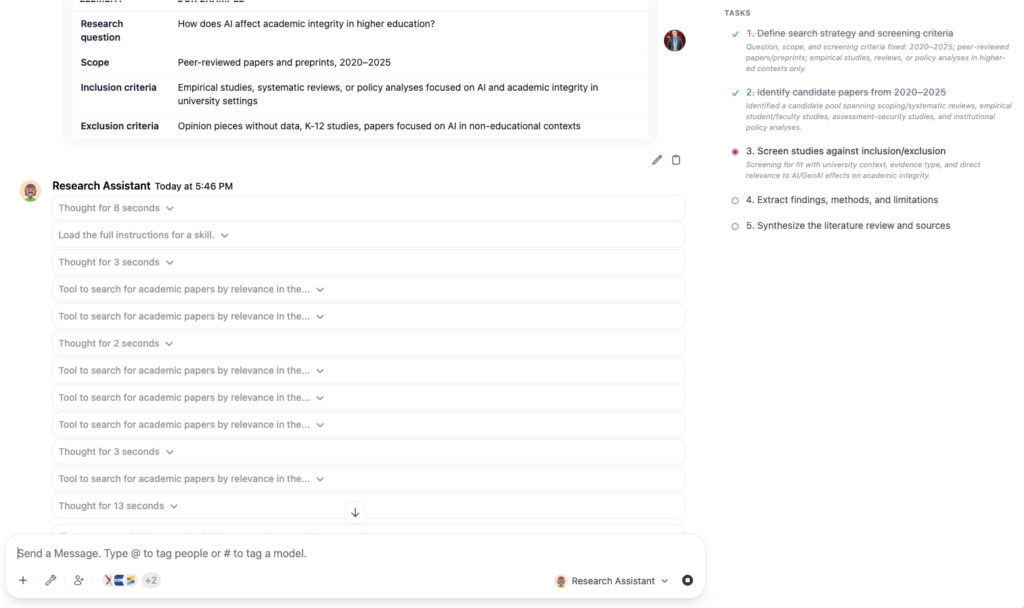
By contrast, in CoChat, you search seven academic databases from a single prompt:
| Database | What It Covers | Why It Matters for This Topic |
|---|---|---|
| arXiv | Preprints in CS, education tech | Catches the newest AI + education research before peer review |
| PubMed | Biomedical and health sciences | Surprisingly relevant — medical education has published heavily on AI integrity |
| Semantic Scholar | 214M+ papers across all fields | Broadest general coverage, strong citation graph |
| OpenAlex | 270M+ open catalog of research | Catches papers from smaller journals and open-access sources |
| CrossRef | 183M+ DOI records | Verifies paper existence and metadata accuracy |
| CORE | 374M records from 13,000+ repositories | Full-text access to open access papers — not just abstracts |
| Europe PMC | 46M+ life science records + preprints | Includes bioRxiv/medRxiv preprints, clinical guidelines |
No other AI research tool searches this many databases. For example, Elicit uses Semantic Scholar. Meanwhile, Consensus uses Semantic Scholar and OpenAlex. CoChat, by contrast, searches all seven simultaneously and deduplicates the results.
A single prompt like “Find peer-reviewed papers on artificial intelligence and academic integrity in higher education, 2020–2025” returns results from all seven sources — merged, deduplicated, and ready to organize.
Step 3: Organize into a literature review table
Here’s what the data extraction table looks like for our example. In CoChat, this is a live, editable literature review table — not a static spreadsheet:
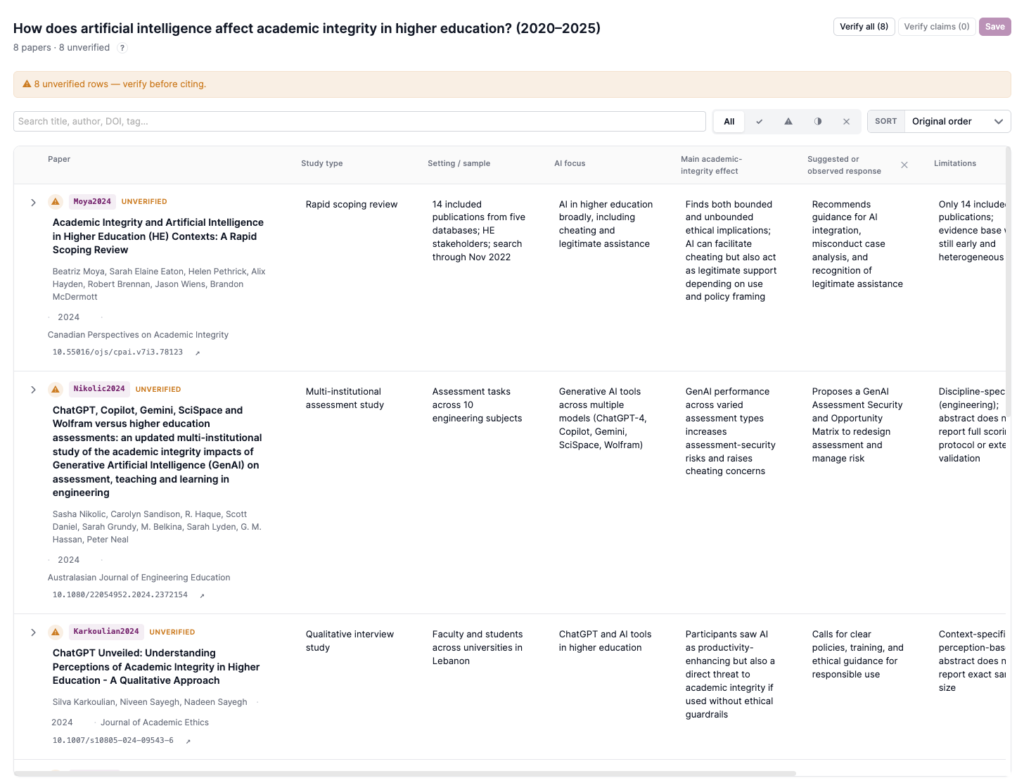
| Paper | Year | Study Design | Sample | Key Finding | Relevance |
|---|---|---|---|---|---|
| Cotton, D.R.E. et al. “Chatting and cheating: Ensuring academic integrity in the era of ChatGPT” | 2024 | Policy analysis | 10 UK universities | Existing academic integrity policies are insufficient for AI-generated content; recommends assessment redesign | High |
| Farazouli, A. et al. “Hello GPT! Goodbye home exam?” | 2024 | Mixed methods | 572 students, 38 faculty | 62% of students reported uncertainty about AI use policies; faculty divided on detection feasibility | High |
| Perkins, M. “Academic Integrity considerations of AI Large Language Models in the post-pandemic era” | 2023 | Literature review | 47 papers reviewed | AI detection tools have high false positive rates (up to 26%); argues against reliance on detection | High |
| Liang, W. et al. “Monitoring AI-Modified Content at Scale” | 2024 | Quantitative analysis | 1.6M peer reviews | Estimated 6.5% of peer reviews partially written by AI; higher in some conferences | Medium |
| Smolansky, A. et al. “Educator Perspectives on the Impact of AI on Teaching and Learning” | 2023 | Survey | 214 educators | 78% of educators see AI as an opportunity; 45% have already adapted assessments | Medium |
Each row is a paper. Each column extracts a specific data point. In CoChat, for instance, you can add custom columns (effect size, methodology details, theoretical framework), and the AI will fill them in by reading the paper.
Step 4: Verify your citations — this is where most reviews fail
Here’s the part nobody talks about.
You’ve read 20 papers. You’ve written sentences like “Cotton et al. (2024) found that existing academic integrity policies are insufficient for AI-generated content.” But did Cotton et al. actually say that? Or did you paraphrase too loosely? Or did the AI that helped you summarize the paper hallucinate the finding?
This is where citation errors creep in. In fact, studies have found that citation errors in academic papers can range from 25% to 80% depending on the field. Most are minor (wrong page number, misspelled author name), but some are substantive — the cited paper doesn’t actually support the claim being made.
Fortunately, CoChat’s claim checker catches these problems automatically.
The Claim Checker: Verify Every Citation Automatically
This is CoChat’s most unique feature for literature reviews — and no competitor offers anything like it.
What it does
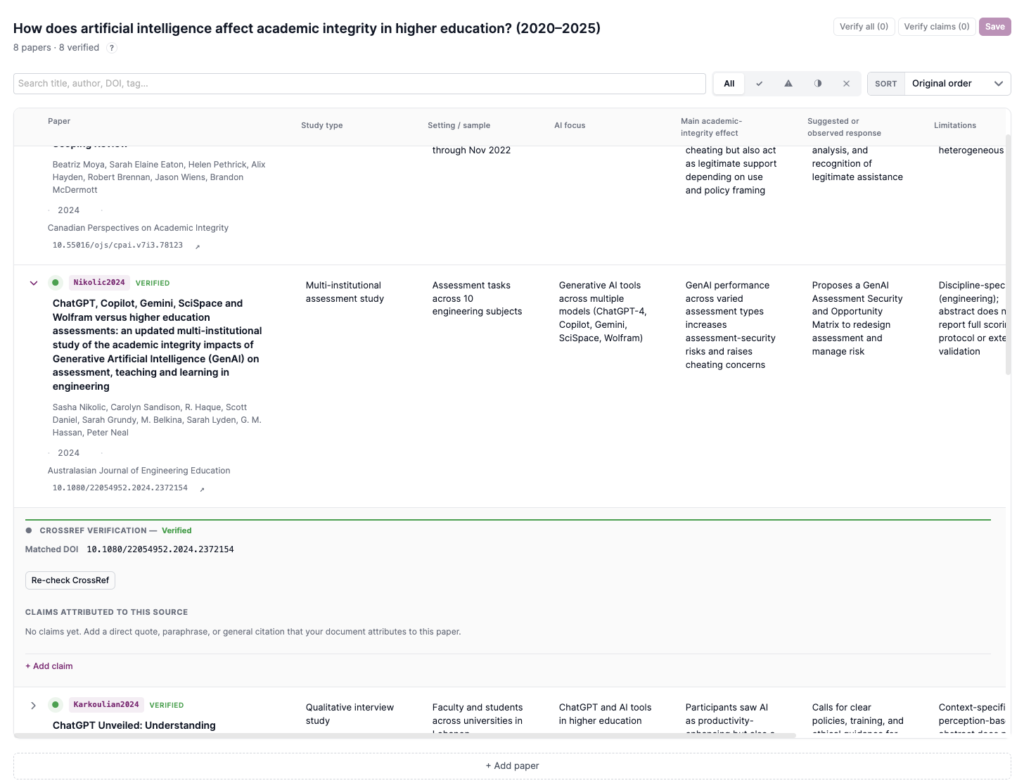
When you add a claim to a paper in your literature review table — a quote, a paraphrase, or a general citation — CoChat verifies it in two ways:
- Paper verification (CrossRef): Does this paper actually exist? Is the DOI valid? Are the authors and year correct?
- Claim verification (Semantic Scholar + AI): Does the paper actually say what you’re attributing to it? Is your quote or paraphrase accurate?
What it looks like
Here’s a real example from a CoChat literature review table:
Verified claim ✅
Paper: Batchelor, O. (2017). “Getting out the truth: the role of libraries in the fight against misinformation”
Claim: “Libraries serve as crucial information checkpoints that help combat the spread of misinformation”
Status: ✅ Verified — claim confirmed in source text
Disputed claim ⚠️
Paper: Batchelor, O. (2017). “Getting out the truth: the role of libraries in the fight against misinformation”
Claim: “The study found that 73% of library users improved their information literacy after attending workshops”
Status: ⚠️ Disputed — this specific statistic was not found in the source paper
The second claim looks plausible. It sounds like something the paper might say. But it doesn’t — the 73% figure was either hallucinated by an AI summary or misremembered by the reviewer. Ultimately, without automatic verification, this error would have made it into the final paper.
Why this matters
| Problem | How Often It Happens | Claim Checker Catches It |
|---|---|---|
| AI hallucinated a citation | ~15-25% of AI-generated citations in some studies | ✅ Paper not found in databases |
| Paper exists but doesn’t say what you claimed | 25-80% of citations contain some error | ✅ Claim not confirmed in source text |
| Wrong author or year | Common in manual entry | ✅ Metadata mismatch flagged |
| Paper has been retracted | Rare but catastrophic for your credibility | 🔶 Partially — flags if paper not found |
| DOI is broken or incorrect | ~5-10% of manually entered DOIs | ✅ CrossRef lookup fails |
Side-by-Side Comparison: Citation Verification Tools
No other AI research tool verifies your specific claims. Here’s how CoChat compares:
| Feature | CoChat | Elicit | Consensus | Scite.ai | Perplexity |
|---|---|---|---|---|---|
| Checks if paper exists (DOI/metadata verification) | ✅ Auto — CrossRef + Semantic Scholar | ❌ | ❌ | ✅ Proprietary index | ❌ |
| Checks if your claim is accurate (source text verification) | ✅ Auto — Semantic Scholar + AI | ❌ | ❌ | ❌ | ❌ |
| What it verifies | Your claim → checked against the source paper | Nothing | Nothing | How other papers cite this paper (support/contrast/mention) | Nothing |
| User action required | One click — “Verify” | N/A | N/A | Automatic (but different purpose) | N/A |
| Databases checked | 7 (arXiv, PubMed, S2, OpenAlex, CrossRef, CORE, Europe PMC) | 1-2 | 2 | 1 (proprietary) | Web crawl |
| Full-text access | ✅ Via CORE open access | ❌ Abstracts only | Partial | ✅ Publisher partnerships | ❌ |
CoChat vs. Scite.ai: Different Problems, Different Solutions
This comparison deserves a closer look because Scite.ai is the only other tool doing anything related to citation verification — but they solve a fundamentally different problem:
| CoChat Claim Checker | Scite.ai Smart Citations | |
|---|---|---|
| Question it answers | “Did I cite this paper correctly?” | “How do other papers cite this paper?” |
| Direction of analysis | Your claim → verified against source | Other papers → classified by how they reference the source |
| Output | ✅ Verified or ⚠️ Disputed for each of your claims | Supporting / Contrasting / Mentioning counts |
| Best for | Writing a literature review and ensuring accuracy before submission | Evaluating a paper’s reputation and how the field views its findings |
| Data required | Access to the cited paper’s text | Access to full text of all papers that cite the source |
| Who needs it | Students, thesis writers, anyone citing papers | Researchers evaluating the strength of evidence |
Both are valuable. They’re not substitutes. If you’re writing a thesis, you need CoChat’s claim checker to make sure your citations are accurate. If you’re evaluating whether a controversial paper’s findings have held up, Scite’s citation sentiment is useful.
The key difference: Scite tells you what the field thinks about a paper. CoChat tells you whether you cited it correctly. Review more details about CoChat vs Scite.
How to Use the Claim Checker: Step-by-Step
The claim checker works best when you have specific, verifiable claims attached to papers — not vague attributions like “Smith et al. discussed the topic.” Here’s the full workflow to get from an empty literature review to verified citations.
Step 1: Build your literature review table
Ask CoChat to search for papers on your topic. Use a prompt like:
Search arXiv, PubMed, and Semantic Scholar for peer-reviewed papers on artificial intelligence and academic integrity in higher education, published 2020–2025. Create a literature review table with columns for study design, sample size, key findings, and limitations.
CoChat searches all seven databases, deduplicates results, and organizes them into a structured table. You now have papers — but no claims yet.
Step 2: Generate a synthesis with citable claims
This is the key step most people miss. Ask the AI to write a short synthesis paper that explicitly cites findings from your table:
Using the papers in my literature review table, write a 500-800 word academic synthesis on “How AI Affects Academic Integrity in Higher Education.” Important: for every claim, cite the specific paper and include a direct quote or specific data point. Don’t write “studies show detection is unreliable” — write “Perkins (2023) found that AI detection tools exhibit false positive rates as high as 26%.” After writing the synthesis, add each claim to the corresponding paper in the literature review table.
The AI will generate something like:
The rapid adoption of large language models has exposed critical gaps in university integrity frameworks. Cotton et al. (2024) conducted a policy analysis across 10 UK universities and found that “existing academic integrity policies are insufficient for addressing AI-generated content.” Meanwhile, Farazouli et al. (2024) reported that 62% of students expressed uncertainty about institutional AI use policies in a mixed-methods study of 572 students and 38 faculty members.
Detection-based approaches remain contentious. Perkins (2023) reviewed 47 studies and found that AI detection tools exhibit false positive rates as high as 26%, concluding that institutions should not rely primarily on detection. However, Liang et al. (2024) estimated that 6.5% of peer reviews at major conferences were partially written by AI, suggesting the scale of the problem may warrant continued detection efforts despite accuracy concerns…
Each bolded finding is now a testable claim. The AI adds these to your literature review table automatically.
Step 3: Verify with one click
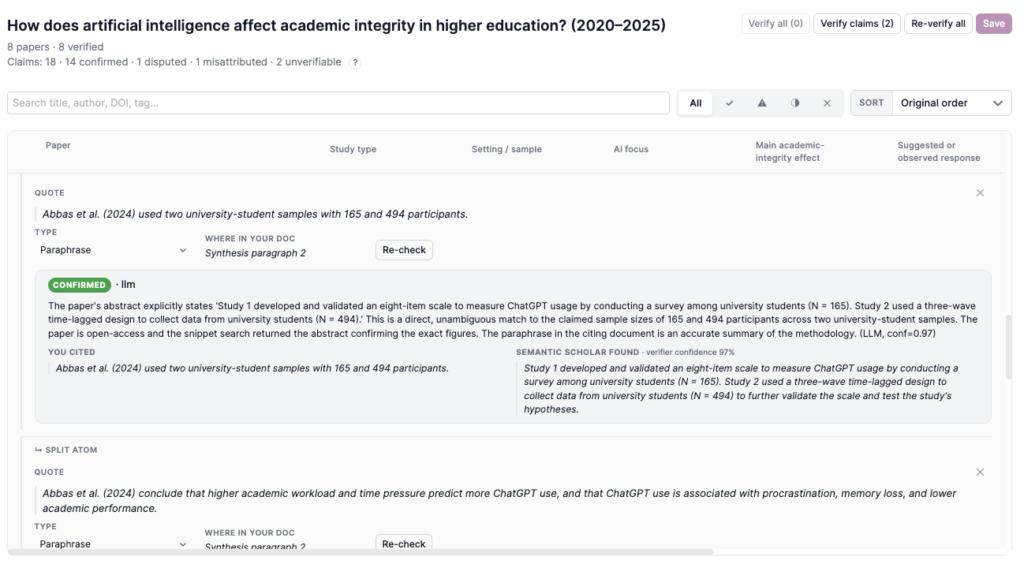
Once claims are attached to papers in your table, click Verify on any claim. CoChat runs two checks:
- Paper check (CrossRef): Does the paper exist? Is the DOI valid? Do the authors and year match?
- Claim check (Semantic Scholar + AI): Does the paper actually contain this finding? Is the quote accurate? Is the statistic real?
Results appear inline:
- ✅ Verified — the claim was confirmed in the source text
- ⚠️ Disputed — the claim could not be confirmed (the paper doesn’t say this, or the statistic doesn’t appear)
- ❌ Unverified — the paper itself couldn’t be found in any database
Why this catches errors
The critical insight: AI-generated citations often contain plausible-sounding claims that are subtly wrong. The AI might:
- Attribute a statistic to the wrong paper
- Round or misremember a percentage (“73%” instead of “71%”)
- Paraphrase so loosely that the original meaning shifts
- Invent a finding that fits the narrative but doesn’t exist in the source
All of these look correct on first read. A human reviewer might not catch them. The claim checker does.
Pro tip: Deliberately test the system
Want to see the claim checker in action? After generating your synthesis, manually add a claim you suspect is wrong — or ask the AI to generate claims about a paper it hasn’t actually read. The disputed ⚠️ flag will show you exactly how the verification catches errors.
This is also a useful exercise for students learning about citation accuracy. Generate AI-written claims, run them through the checker, and discuss which ones pass and which don’t — and why.
Literature Review Format: APA, MLA, and Beyond
Your literature review template needs to fit your required format. Here’s how the same content adapts:
APA Format Example (most common in social sciences, education, psychology)
The emergence of large language models has raised significant concerns about academic integrity in higher education. Cotton et al. (2024) conducted a policy analysis across 10 UK universities, finding that existing academic integrity policies are insufficient for AI-generated content. Similarly, Farazouli et al. (2024) reported that 62% of students expressed uncertainty about AI use policies in a mixed-methods study of 572 students and 38 faculty members.
Detection of AI-generated content remains contentious. Perkins (2023) reviewed 47 studies and found that AI detection tools exhibit false positive rates as high as 26%, arguing against institutional reliance on detection-based approaches.
Key formatting notes by style
| Style | In-Text Citation | Common In |
|---|---|---|
| APA 7th | (Cotton et al., 2024) | Psychology, education, social sciences |
| MLA 9th | (Cotton et al. 12) | Humanities, literature, cultural studies |
| Chicago 17th | Cotton et al., “Title,” 12. | History, arts, some social sciences |
| Vancouver | Cotton et al. [1] | Medical and health sciences |
CoChat exports your literature review table with proper citation formatting. You can also generate a formatted reference list from your table.
Your Complete Literature Review Checklist
Use this checklist to make sure your review is complete before submission:
Research & Search
- Research question clearly defined with specific scope
- Inclusion and exclusion criteria documented
- Searched at least 3 databases (CoChat searches 7 automatically)
- Search terms and strategy recorded for reproducibility
- Duplicates identified and removed
Organization & Extraction
- All papers entered in a structured table with consistent columns
- Key data extracted: authors, year, design, sample, findings, limitations
- Papers tagged or grouped by theme
- Gaps in the literature identified
Verification — Most People Skip This
- Every citation verified — paper exists and is correctly referenced
- Every claim checked — paraphrases accurately represent the source
- DOIs confirmed as valid
- Checked for retracted papers
- No AI-hallucinated citations remain
Synthesis & Writing
- Themes organized logically (chronological, thematic, or methodological)
- Conflicting findings acknowledged and discussed
- Gaps explicitly stated as areas for future research
- Formatted in required citation style (APA, MLA, Chicago, Vancouver)
Export & Submission
- Reference list generated from your table
- Exported in required format
- Internal links between table and narrative checked
Start Your Literature Review Now
You can use the template above with any tools you like — a spreadsheet, a Word doc, or a dedicated reference manager.
But if you want to search seven databases simultaneously, organize papers into a verified table, check every claim automatically, and export everything from one workspace — try CoChat for free.
No credit card required. Your first literature review takes about 15 minutes.
Related Guides
- AI Literature Review: Search, Organize, and Export — From One Conversation
- How to Build an AI Literature Review in Half the Time
- CoChat Now Searches 7 Academic Databases — More Than Any AI Research Tool
- The Best AI Research Tools in 2026 – A Definitive Comparison Guide
Frequently Asked Questions
What is a literature review template?
A literature review template is a pre-built structure that guides you through organizing, analyzing, and writing about existing research on a topic. It typically includes sections for your research question, search strategy, data extraction table, synthesis, and reference list.
How long should a literature review be?
A literature review for a thesis chapter typically runs 3,000–10,000 words. For a journal article, 1,500–3,000 words. For a class assignment, 1,000–2,500 words. Length depends on the scope of your research question and the number of papers reviewed.
What is the difference between a systematic and narrative literature review?
A systematic review follows a strict, reproducible protocol — predetermined search strategy, inclusion/exclusion criteria, and often quantitative synthesis (meta-analysis). A narrative review is more flexible, allowing the author to interpret and synthesize themes without a rigid protocol. Systematic reviews are considered higher evidence; narrative reviews are more common in theses and coursework.
How do I know if an AI-generated citation is real?
Check the DOI against CrossRef (doi.org), search the title in Semantic Scholar or Google Scholar, and verify the authors and year match. CoChat does this automatically — its claim checker validates both the paper’s existence and whether your specific claim about the paper is accurate.
What databases should I search for a literature review?
At minimum, search 2-3 databases relevant to your field. For comprehensive coverage, search across disciplines: PubMed (biomedical), arXiv (STEM preprints), Semantic Scholar (general), OpenAlex (open access), and CORE (institutional repositories). CoChat searches seven databases simultaneously, ensuring you don’t miss papers that exist in only one index.
Can AI write my literature review for me?
AI can help you search, organize, extract data, and draft sections — but a literature review requires critical analysis and synthesis that you should own. Use AI to accelerate the mechanical work (searching, organizing, formatting) and spend your time on what matters: interpreting findings, identifying gaps, and constructing your argument. Always verify AI-generated citations before submitting.