


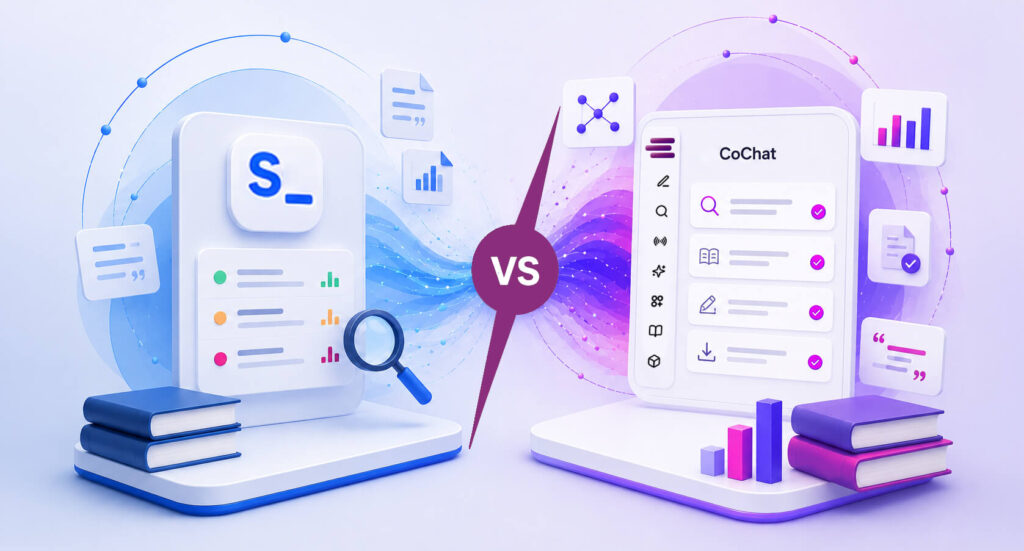
If you’re researching the CoChat vs Scite decision, you’ve spotted something most tool roundups miss. Both products promise “citation trust,” but they mean opposite things by it. Scite tells you how a published paper was received by the researchers who cited it later. CoChat verifies that the citations in your own work are real and that the claims around them hold up. One looks backward at the literature’s verdict on a source. The other looks forward at the integrity of what you’re about to submit.
That distinction decides which tool belongs in your workflow. So this guide compares both honestly, feature by feature, with Scite’s numbers pulled straight from its own site and pricing page. We’ll name the one job Scite does that nothing else matches. Then we’ll show why, for most researchers writing and defending their own work, CoChat is the AI research tool that closes the loop Scite leaves open.
TL;DR: The 15-second verdict
- Choose CoChat if you’re producing research you have to defend: you need to search across databases, read the full text, verify every citation against CrossRef, cross-check claims across multiple models to catch hallucination, and export a finished literature review. This is the everyday reality of writing a paper, thesis, or grant.
- Choose Scite in one specific case: you want to see how the existing literature has cited a paper, whether later studies supported or contrasted it, using its Smart Citations index. Nothing else does that at Scite’s scale.
- The honest bottom line: Scite evaluates how other people’s published work was received. CoChat verifies that your work is sound before it goes out. They sit on different sides of the research process. If you’re the one writing, the CoChat vs Scite choice comes down to which side you spend your time on.
Now the long version.
What is Scite?
Scite is an AI-powered citation-analysis platform built around one standout idea: Smart Citations. Most tools just count how many times a paper has been cited. Scite goes further. It reads the citing sentences and classifies each one as supporting, contrasting, or mentioning the original work. Scite has indexed 1.6 billion citation statements across 280 million scholarly sources and serves more than 2 million users. It is now part of Research Solutions, with direct agreements across 30 to 40 publishers including Wiley and SAGE. You can apply that classification to a paper, a claim, a method, a journal, an author, an institution, or a funder.
Scite’s standout features
Smart Citations. This is the signature capability. When you open a paper in Scite, you see tallies of how later research supported, contrasted, or simply mentioned it. It’s genuinely valuable for gauging whether a finding has held up or been challenged, and nothing else offers it at this scale.
Reference Check. Upload a manuscript and Scite scans its reference list. It flags citations to papers that later work retracted, corrected, or heavily contrasted. For anyone about to submit, it’s a useful safety net against citing a discredited source.
Scite Assistant. This is an AI research assistant that answers questions grounded in the literature. It links each claim back to the specific sentence in the specific paper it came from. It leans on Scite’s evidence signals rather than generating unsupported text.
Search and Collections. Scite offers full-text search across 280 million articles, preprints, books, patents, and datasets. You can save Collections of up to 1,000 papers on Basic and up to 10,000 on higher tiers.
Beyond journal articles. Scite’s database extends to patents, clinical trials, grants, preprints, and datasets. So you can trace an idea from funded proposal to published finding to commercial application.
Works where you work. Scite runs inside Claude, ChatGPT, and any MCP-compatible assistant. It also plugs into Zotero and offers an API for teams building their own tools.
That’s a powerful analytical library. The question is what happens when you stop evaluating other people’s papers and start writing your own.
What is CoChat?
CoChat is an AI research assistant built on a different premise. The citation problem doesn’t end when you learn how a source was received. It ends when you’ve verified that the sources in your own draft are real, that you’ve read what they actually say, and that your claims aren’t a confident hallucination.
Where Scite is a citation-intelligence library, CoChat is a research workspace. Its agent carries a project from question to finished, defensible artifact.
Research and verification
Deep Research Mode. This is CoChat’s flagship research engine, and it shows the multi-model approach at work. One request fans out into several layers of independent investigation and comes back as a single, fully cited report. A lead model plans the question and splits it into parallel slices. Research sub-agents gather sources across CrossRef, Semantic Scholar, and arXiv into a shared evidence pool. A second model runs its own blind investigation of the whole question. Then CoChat reconciles the two passes and runs a skeptical verification check before you see a word. It handles rigorous, source-backed investigations you can defend, and it beats every frontier model published to date on Perplexity’s public DRACO benchmark.
Multi-model consensus for hallucination detection. CoChat runs your question through more than one model and cross-checks their answers. When one model states a confident but wrong claim, the others flag it. Scite grounds its own Assistant in real papers to avoid fabrication, which is a strong single-model approach. CoChat adds a second, independent layer on top. Agreement across models catches the hallucination that any one model can’t see in itself.
CrossRef citation verification. CoChat checks every paper it plans to cite against CrossRef and Semantic Scholar. So it catches fabricated or transposed DOIs before they land in your reference list. This is the exact inverse of Scite’s Reference Check. Scite tells you if a real paper you’re citing was later retracted. CoChat tells you if the paper your AI just cited is real at all.
Full-text reading, not just abstracts. CoChat resolves papers to open-access full text and reads the body. So its answers rest on what the paper actually reports. It’s honest about paywalls too. When a paper has no open-access version, CoChat says so rather than guessing.
Study, collaboration, and workflow
Literature Review Tables. CoChat builds structured, verified literature review tables. Each row is a real, DOI-checked source, and it exports to BibTeX, RIS, or CSV. So the tables drop straight into Zotero, your reference manager, or a manuscript.
Artifacts beyond citations. CoChat also generates flashcard decks with Anki export, dashboards, and documents. These are the outputs a student or researcher needs downstream, made in the same place you did the research.
Real team collaboration. Shared projects, artifacts, and automations mean a verified review or a scheduled weekly search lives where your whole lab or class can work on it. Everyone can see it, check it, and build on it.
Automation and 200+ integrations. CoChat runs recurring searches and lets you build assistants for repeatable research tasks. Then it connects the rest of your stack into the workflow.
In short: Scite tells you how the world received a paper. CoChat helps you build work the world can trust.
Looking back vs looking forward
Here’s the distinction that matters most, and it’s easy to miss because both tools talk about citations and evidence. Scite works on downstream citation reception. It looks at papers that already exist and shows you how the community cited them afterward. It’s a rearview mirror on the literature, and an excellent one. CoChat works on upstream citation integrity. It verifies the sources and claims in the work you’re creating right now, before it ever reaches a reviewer.
These aren’t competing answers to the same question. They’re different, largely complementary axes. Scite is strongest when you’re evaluating a source someone else published. CoChat is strongest when you’re producing something and need every citation in it to be real, read, and defensible. Knowing which side of that line your day-to-day work sits on is the whole decision.
CoChat vs Scite: Head-to-Head
We’ve built this around the questions researchers actually ask when choosing a tool, not a raw feature dump, and given the honest verdict on each.
| What you need to do | Scite | CoChat | Better fit |
|---|---|---|---|
| See whether a published finding was supported or contrasted | Smart Citations across 1.6B statements | Not offered | Scite |
| Check a draft’s references for retractions or disputes | Reference Check | Not a dedicated feature | Scite |
| Verify the citations in your own work are real | Not its focus | CrossRef + Semantic Scholar DOI checks | CoChat |
| Catch AI hallucinations in a claim | Assistant grounded in real papers | Multi-model consensus cross-checks answers | CoChat |
| Run a full, cited investigation end to end | Assistant answers grounded in citations | Deep Research Mode, multi-agent and verified (71.1 DRACO) | CoChat |
| Produce an export-ready literature review | Collections and citation reports | Verified Literature Review Tables to BibTeX / RIS / CSV | CoChat |
| Write and synthesize in one workspace | Analytical lookup and reading library | Full workspace plus artifacts | CoChat |
| Collaborate as a team | Shared Collections on Team plan | Shared projects, artifacts, and automations | CoChat |
Scite honestly wins the first two rows, and we left them in on purpose. Its Smart Citations and Reference Check do something CoChat does not attempt. Saying so plainly is what makes the rest of the table credible. The rows split the way they do because the two tools serve different halves of research. Scite assesses the literature. CoChat produces verified work within it.
The one area where Scite is the better pick
Let’s be fair: for one job, Scite is genuinely the right tool, and pretending otherwise would just cost us your trust.
Where Scite shines
Say you need to know how a specific paper has been received by the field, whether later studies backed it up or pushed against it. Scite’s Smart Citations are unmatched here. Reading 1.6 billion citation statements and classifying them as supporting, contrasting, or mentioning is a real feat of engineering. No general research workspace, CoChat included, replicates that index. For a systematic reviewer assessing whether a key source is contested, that reception signal is exactly the right lens. It helps just as much when you’re deciding whether to build on a finding. Reference Check adds a second strong use case. It catches a retracted or corrected source in your bibliography before a reviewer does.
Where its scope ends
One fair caveat keeps the researcher in the driver’s seat. Scite classifies the large majority of Smart Citations as “mentioning” rather than supporting or contrasting. And any automated classifier will occasionally mislabel the tone of a citing sentence. So the label is a starting point, not a verdict. You still open the citing paper and read the context yourself to confirm what the classification implies. That’s not a knock on Scite. It’s simply how any citation-context tool should be used.
The moment your work shifts from evaluating other people’s papers to writing and defending your own, you’ve reached the edge of what a citation-analysis library is built to do.
Where CoChat pulls ahead
CoChat’s advantages show up the instant your work moves from “how was this paper received?” to “is the work I’m producing sound?”
Two layers of trust on your own work. Scite’s Reference Check confirms that a real paper you’re citing wasn’t retracted. CoChat’s CrossRef verification goes after a different failure that matters more in the age of AI writing: whether the paper exists at all. CoChat catches fabricated and transposed DOIs before they reach your reference list. So an AI-invented citation never survives to your bibliography. When the deliverable is graded, submitted, or published, that guardrail keeps you the author who verified the sources.
Hallucination detection through multiple models. Grounding an AI in real papers, as Scite’s Assistant does, reduces fabrication. CoChat goes further and cross-checks the answer across multiple models. That catches the confident, fluent claim a single model gets wrong and can’t detect in itself. We put this on the record. CoChat’s Deep Research Mode scores a normalized 71.1 on the public DRACO benchmark. We publish the full methodology and every score, so you can check the result yourself rather than take our word for it.
A workspace, not just a lookup. Scite analyzes and reads. CoChat produces: verified literature review tables, exportable citations, flashcards, dashboards, and full documents. It does all of it in the same place you ran the search. You don’t hand off from a research tool to a writing tool and lose your sources in the gap.
Research your whole team can check. Scite offers shared Collections on its Team plan. CoChat extends collaboration across the whole workflow. Shared projects, shared artifacts, and shared automations mean your lab, class, or company can see a verified review, check it, and build on it together.
Pricing: Scite vs CoChat
Here’s what Scite costs in 2026, straight from its pricing page.
| Plan | Scite price | What you get |
|---|---|---|
| Basic | $20/mo | Unlimited Assistant queries, Full-Text Search, Smart Citation Reports, Citation Alerts, 250 MCP credits/mo, Collections up to 1,000 papers |
| Pro | $50/mo | Everything in Basic, plus 2,500 MCP credits/mo, Collections up to 10,000 papers, search across patents, clinical trials, and grants |
| Team | $50/seat/mo | Everything in Pro, plus private and shared Collections, team analytics, centralized billing, 1 seat included, add up to 15 seats at $50 each |
| Enterprise | Custom | Everything in Team, plus unlimited users, API access, regulatory and safety datasets, SAML/SSO, dedicated success manager |
Scite offers a 7-day free trial rather than a permanent free tier. After the trial, Scite enrolls you in the plan you selected unless you cancel first. Students and academics can request a discount by recommending Scite to their institution. Note the credit model, too. Scite meters usage in MCP credits, at 250 per month on Basic and 2,500 per month on Pro. So heavier automated use draws down a monthly allowance.
CoChat uses flat, predictable plans rather than a per-action credit system. So you’re not rationing credits mid-project. For CoChat’s current plans and any student pricing, check the CoChat pricing page directly, since plans evolve.
The bigger point on cost: compare per outcome, not per month. Price a citation-reception lookup against the minutes it saves you assessing a source. Price a verified, export-ready literature review, with every DOI checked, against the hours and the bad-citation risk it removes from work you have to defend.
Which AI research tool should you choose?
Here’s how the CoChat vs Scite decision breaks down. Match the tool to which half of research you spend your time on.
Choose Scite if:
- You mainly need to evaluate how existing papers were received by the field.
- Smart Citations (supporting, contrasting, mentioning) is the signal you want.
- You want to screen a bibliography for retracted or disputed sources.
Choose CoChat if:
- You’re producing research you have to write, cite, and defend.
- Citation integrity is non-negotiable because the work is graded, submitted, or published.
- You want multi-model hallucination detection, verified literature review tables, full-text grounding, and export-ready outputs.
- You want a shared workspace and automations for a team, not a solo lookup tool.
The tie-breaker: Scite is the better pick when your job is judging the literature. CoChat is the better pick when your job is producing work within it. For most students, PhD candidates, and grant writers, that’s where the hours actually go. Many researchers will find value in both. But if you can only invest in one, invest in the tool that verifies the work with your name on it.
Frequently asked questions
Is CoChat or Scite better for a literature review? For assessing whether the key sources in your field were supported or contrasted, Scite’s Smart Citations are excellent. For producing the review itself, CoChat’s verified Literature Review Tables are built for that deliverable. Every citation is DOI-checked and exportable to BibTeX or RIS. If the review has to hold up to scrutiny as your work, that verification step is where CoChat pulls ahead.
Does CoChat do Smart Citations like Scite? No, and we won’t pretend it does. Scite’s Smart Citations index holds 1.6 billion classified citation statements. That’s its own engineering achievement, and CoChat does not replicate it. CoChat works on the other side of the process. It verifies that the sources in your own work are real and that your claims aren’t hallucinated. They’re complementary tools for different jobs.
Can I trust the citations from an AI research tool? Scite grounds its Assistant in real papers and links each claim to a specific sentence, which reduces fabrication. CoChat adds two more layers on your own work. It verifies each citation against CrossRef and Semantic Scholar to catch fabricated or transposed DOIs. It also cross-checks answers across multiple models, so a hallucination from one gets flagged by the others. You stay the one who verifies the sources, which matters most when the work is graded or published.
Is either tool free? Scite offers a 7-day free trial rather than a permanent free plan. After it ends, Scite enrolls you in your selected paid tier unless you cancel. Check CoChat’s pricing page for its current free and paid options.
Which is the better AI research tool overall? It depends which half of research you live in. Scite is the stronger tool for evaluating how published work was received. CoChat is the stronger tool for producing verified, defensible research of your own. It owns the whole workflow, from search to cited, checked deliverable.
Key figures and technical detail
For readers who want the specifics behind the comparison, here are the details worth knowing.
Scite’s index. Scite has indexed 1.6 billion citation statements across 280 million scholarly sources and serves more than 2 million users. It is now part of Research Solutions and holds direct agreements with 30 to 40 publishers, including Wiley and SAGE. Those agreements are how it reads full text behind paywalls that block other tools.
What Smart Citations classify. Scite applies its supporting, contrasting, or mentioning classification beyond papers. It also covers claims, methods, journals, authors, institutions, and funders. So you get an evidence signal at several levels of granularity.
Coverage beyond journals. Scite’s database extends to patents, clinical trials, grants, preprints, and datasets. That lets you trace an idea from funded proposal through publication to commercial application.
Ecosystem. Scite runs inside Claude, ChatGPT, and MCP-compatible assistants. It plugs into Zotero and offers an API. Its core products are Scite Assistant, Search, Reference Check, and Collections.
Credit metering. Scite’s plans include a monthly MCP credit allowance, at 250 on Basic and 2,500 on Pro and Team per user. That allowance caps automated and assistant-heavy use. CoChat’s flat plans avoid per-action credit rationing.
CoChat’s benchmark. CoChat’s Deep Research Mode posts a normalized 71.1 composite on Perplexity’s public DRACO benchmark, ahead of every frontier model published to date. CoChat publishes the full methodology and scores openly.
The bottom line
The CoChat vs Scite choice isn’t really about which tool is “better.” It’s about which half of research you need help with. Scite is a sharp, one-of-a-kind citation-analysis library. Its Smart Citations are the right call when you need to know how the field received a paper. That’s a real strength no general workspace matches.
Then there’s the other side of the process: writing the work, verifying that every source in it is real, catching the hallucination before it reaches your draft, and walking away with a cited deliverable you can defend. That’s what CoChat was built for. Most researchers spend their hours producing work rather than only judging others’ papers. So CoChat is the AI research tool worth building your workflow around.
Ready to see the difference verified citations make? Try CoChat free and run your next literature review with sources you can actually trust.
Keep comparing
This CoChat vs Scite breakdown is one of five head-to-head comparisons in our guide to the best AI research tools in 2026. See how CoChat stacks up against the rest:
- CoChat vs Consensus: fast evidence triage vs a verified workflow
- CoChat vs SciSpace: reading comprehension vs verified production
- CoChat vs Elicit: a systematic-review specialist vs the whole workflow
- CoChat vs Gemini Notebook: studying your sources vs finding and verifying them
