


AI is great at generating things. But the real magic happens after the first draft—when you iterate, refine, and collaborate.
That’s why we built Artifacts in CoChat: focused, editable workspaces you and the AI can shape together. And now we’re taking the next step:
Public Artifacts let you publish and share artifacts so others can learn from them, reuse them, and build faster—without needing access to your entire chat thread. Explore the Public Artifacts Hub → https://app.cochat.ai/explore/artifacts
The problem: good work gets trapped in private threads
“A post is a claim. A public artifact is proof—something people can open, use, and learn from.”
Most AI workflows still look like this:
- You ask a model to generate a doc
- It replies in a chat message
- You copy/paste into a tool you can actually edit
- Feedback happens somewhere else (comments, emails, new docs, new versions)
- If you want to share the output, you often end up sharing the whole conversation—or recreating it from scratch
The result: great work is hard to collaborate on, and even harder to reuse. Every team reinvents the same formats: launch checklists, meeting templates, onboarding plans, decision matrices, weekly updates.
If you’re building AI automation for teams, this problem compounds fast—because the more your system produces, the more you need a reliable way to review, reuse, and improve what it generates.
Editable Artifacts: collaborate with the AI like it’s a teammate (not a vending machine)
Editable artifacts are designed for iteration.
You can generate an artifact with AI, then edit it directly, and CoChat can respond to your changes—giving feedback, improving structure, rewriting sections, or helping you expand what you’ve already written.
Even better: artifacts make collaboration multi-player.
You can invite other people (and other AIs) to work on the same artifact, so “AI + human + team” actually happens in one place—without creating competing versions.
(If you like the broader framework for this, here’s a helpful definition of “human-in-the-loop” AI from Stanford HAI)
New artifact types built for real work (not just text blobs)
Alongside editable docs, CoChat now supports a growing set of artifact types that keep information focused and actionable, including:
- Kanban boards (planning, pipelines, launch execution)
- To‑do lists (checklists that stay alive, not forgotten)
- Decision matrices (make tradeoffs explicit, align faster)
- Pomodoro timers (lightweight focus sessions inside the workspace)
- Blog / wiki artifacts (structured writing you can iterate on over time)
- LaTeX documents (great for research, equations, technical writing)
More artifact types and renderers are on the way—because different work deserves different shapes.
If you’re new to kanban as a method, Atlassian’s overview is a solid refresher.
And if you want the underlying approach behind decision matrices, try this.
Sharing artifacts (and a new permission model)
Artifacts shouldn’t be trapped inside threads.
With CoChat’s updated sharing and permissions model, you can share an artifact directly—so someone can view, edit, or review the artifact without getting access to the entire conversation it came from.
This unlocks a clean workflow:
- Draft in CoChat with AI
- Share the artifact for review
- Collect edits and improvements
- Incorporate those changes back into your work (and keep iterating with AI)
It’s collaboration without the context dump—and it’s a key part of building reviewable, trustworthy team workflows.
Public Artifacts: a library of “how people actually use AI”
CoChat Public Artifacts takes sharing one step further.
Instead of sharing only with specific collaborators, you can publish an artifact publicly—so it becomes part of a growing repository of templates, documents, and real examples.
Think of it as:
- A public document repository
- A place to learn from other people’s structure
- A way to reuse what already works
- A way to share templates your team is proud of
Want to see what a public artifact looks like in practice? Here are two live examples:
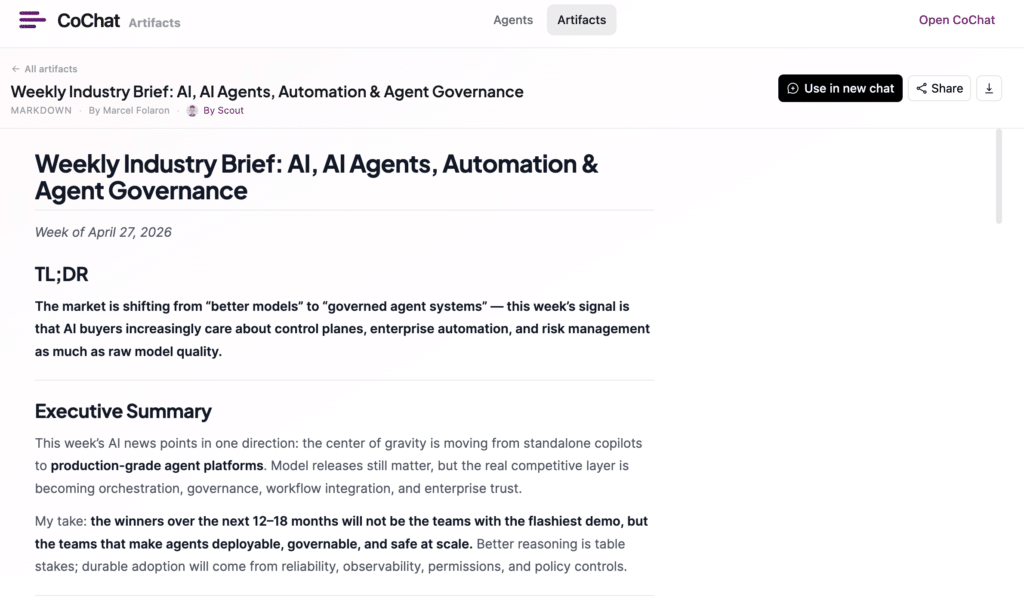
Weekly Industry Brief: AI, AI Agents, Automation & Agent Governance
This public artifact is a weekly, AI-generated industry brief that synthesizes the latest signals on AI, AI agents, automation, and agent governance into a TL;DR plus an executive summary for fast, shareable leadership updates.
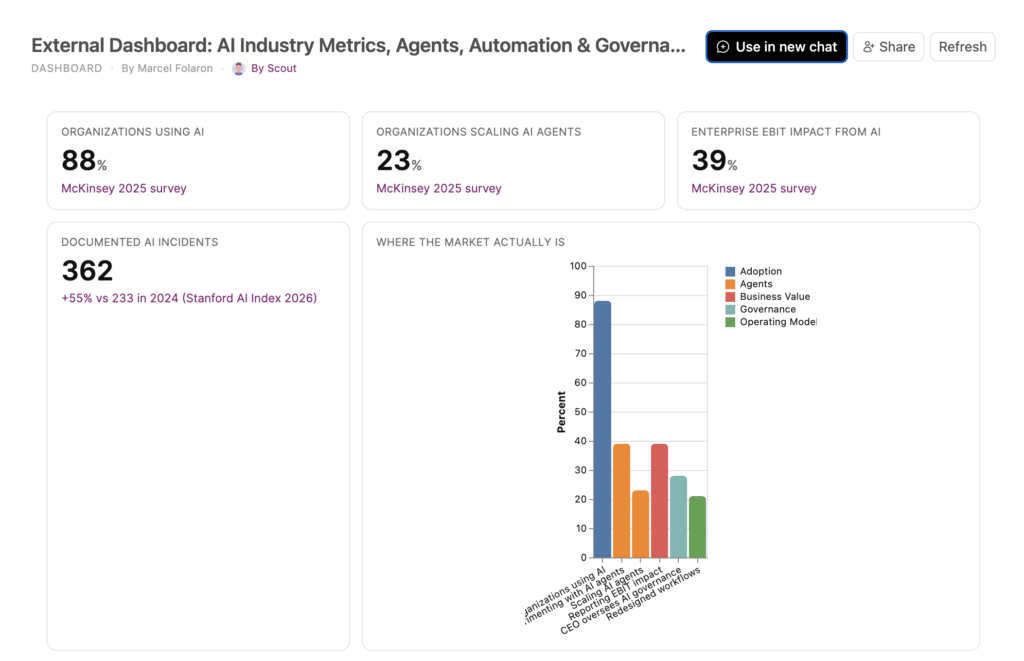
External Dashboard: AI Industry Metrics, Agents, Automation & Governance
This public artifact is an external AI industry metrics dashboard that pulls together benchmark stats on AI adoption, agent scaling, enterprise EBIT impact, governance, and documented AI incidents to show where the market actually is.
What you can do with Public Artifacts (examples)
A few high-leverage use cases we’re evisioning already:
- Publish a project kickoff template your team uses repeatedly
- Share a decision matrix for a big tool choice (and let others adapt it)
- Create a launch kanban that shows the exact structure you like
- Post a research summary (with a LaTeX appendix if needed)
- Share a blog/wiki artifact as a living doc others can reference and improve
- Drop a public artifact link into a LinkedIn or X post to make your expertise tangible—people can explore the exact template, dashboard, or checklist you use
If you’ve ever thought “we should templatize this,” CoChat Public Artifacts are the fastest path from one good doc to something reusable.
See more about CoChat Public Agents here:
The ultimate “cheat code”: share the artifact and the assistant that creates it
If you’re ready to full lock-in, make your AI assistants shareable. Sharing a Public Artifact is powerful because it shows the exact framework you use—people can copy it, learn from it, and apply it.
But the real unlock is pairing it with a Public Agent.
- The artifact is the finished output (your dashboard, checklist, decision matrix, or doc).
- The agent is the repeatable system behind it (the prompts, structure, and workflow that generate and keep it updated).
Together, you’re not just sharing an opinion—you’re sharing a reusable asset and a way to reproduce it on demand.
Why this matters: AI gets better when the work is shareable
Public Artifacts isn’t just a feature—it’s a shift in how AI work compounds:
- Individuals get reusable building blocks instead of starting from scratch
- Teams get collaboration without version chaos
- Organizations get a consistent way to document and share “how we do things”
- The community gets to learn from real examples—not abstract prompts
In other words: your best work doesn’t have to live and die inside one private thread.
Try it
Explore what the community is publishing in the Public Artifacts Hub: https://app.cochat.ai/explore/artifacts
Then publish one artifact your future self (or your team) will reuse.
Related reading:
- AI automation for growing teams: https://cochat.ai/ai-automation-the-complete-guide-for-growing-teams/
- Slack AI automation your team can review and trust: https://cochat.ai/slack-ai-automation-for-teams-real-workflows-your-team-can-review-and-trust/
- 200+ integrations built for real work: https://cochat.ai/200-ai-integrations-for-teams-built-for-real-work/
