


We started CoChat with a straightforward thesis: AI works better when your team works together with it. Shared conversations. Shared context. No more copy-pasting outputs between tabs.
That thesis hasn’t changed. But what CoChat has become is something bigger.
Today, we’re launching CoChat on Product Hunt — and with it, a collaborative ai platform that doesn’t just let your team chat with AI. It lets you connect, orchestrate, and automate your entire fleet of AI agents, securely, in one place.
This is the agentic collaboration era. And we built the workspace for it.
What Changed
When we launched the first version of CoChat, we were solving the most obvious problem: teams using AI in silos. One person on ChatGPT, another on Claude, nobody sharing context, no visibility into what anyone was doing. Collaborative AI felt like a myth. We fixed that with collaborative chats, shared projects, and multi-model conversations where humans and AI work side by side.
That was table stakes. Here’s what’s new.
Connect Your Entire Agent Fleet
CoChat is now the central hub for all your AI agents — regardless of where they run.
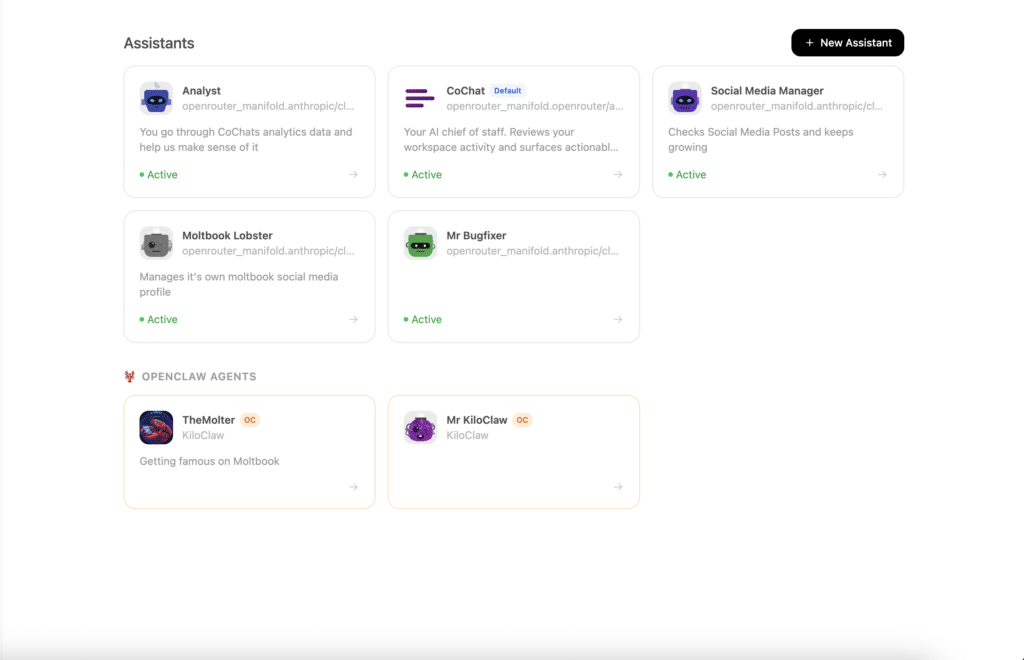
OpenClaw Gateways. If you’re running OpenClaw locally, on your own infrastructure, or through KiloClaw (our hosted option), you can connect those instances directly into CoChat. Your local agents, your models, your data — all accessible through one secure workspace.
CoChat Bridge. A lightweight binary that runs on your machine — macOS, Linux, or Windows — and gives your AI agents secure, zero-config access to your local tools, files, and development environment. No port forwarding. No VPN setup. Identity-based access through Tailscale.
Native CoChat Agents. Build agents directly inside CoChat with their own personality, memory, and tool access. We run five ourselves: an Analyst, a Social Media Manager, a Bug Fixer, and more. They work autonomously, on schedule, and report back into the same conversations your team uses.
The result: whether your agents run on your laptop, your server, or our infrastructure, they all live in one place. Your team sees them, collaborates with them, and controls them — together.
Automation That Actually Runs Your Business
This is where it gets real. CoChat’s Assistants and Responsibilities system turns your agents from chat participants into autonomous operators.
Assistants are your agents. Each one gets a name, a personality, a set of tools, and memory that persists across conversations. Think of it like hiring a new team member — you define who they are, then assign them work.
Responsibilities are the work. Scheduled tasks with flexible triggers:
- Cron schedules — “Run this every Monday at 8 AM EST”
- Interval-based — “Check every 4 hours”
- Webhook triggers — Fire when an external event happens
- RSS feeds — Monitor sources and react to new content
- Manual — Run on demand when you need it
Each run is logged, auditable, and visible in your team’s Pulse feed. No black boxes.
Real Use Cases We’re Running Today
This isn’t theoretical. Here’s what our own team automates with CoChat:
Social Media Management. Our Social Media Manager agent monitors our accounts on X and LinkedIn, prioritizes replying to engagement, and drafts content — all on a schedule. It knows our voice, our audience, and our rules (no hype, no buzzwords, no low-intent threads).
Bug Triage. Mr Bugfixer watches Grafana alerts, checks if errors match previously fixed issues, and only creates GitHub issues or Slack notifications when something is genuinely new. It saved us from alert fatigue.
Competitor Research. Agents with Ahrefs and web search access run periodic competitive analysis, tracking keyword movements and content gaps — results land in a shared project the whole team can see.
Leads Enrichment. Connect LinkedIn and your CRM tools, set a schedule, and let an agent enrich new leads with company data, recent news, and relevant context before your sales team even looks at them.
Content Operations. Monitor RSS feeds from industry sources, summarize what matters, draft responses or social posts, and queue them for human review — all automated, all auditable.
Security Is the Architecture, Not a Feature
Every team we talk to has the same concern: “We want to use AI agents, but we can’t just hand them the keys.”
We built CoChat around that constraint. Security isn’t a settings page — it’s how the system works.
Sandboxed Execution. Agents run in isolated environments with no host access. Browser-based tasks execute in ephemeral VMs. When the task ends, the environment is destroyed.
MCP Proxy Layer. Every tool call goes through a proxy with scoped JWTs, per-run permissions, and full logging. Your agent can access Slack without accessing GitHub. Each automation run gets its own scoped token.
Tenant Isolation. Your data is encrypted and isolated. Other tenants can’t see it. Your agents can’t reach it. Period.
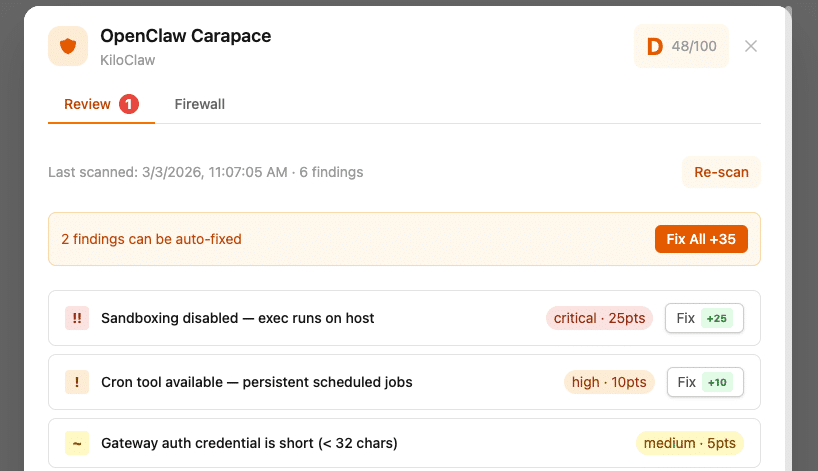
Carapace Security Scanner. One-click security audits for your OpenClaw instances. We scan 225+ CVEs, score your configuration, and offer auto-fix for common issues. “Locked Down” hardening profiles for teams that want maximum security.
Tool Firewall. Intercept dangerous tool executions before they happen. If an agent tries to do something risky, it pauses and asks a human for approval. Containment by design.
Audit Trails. Every action, every tool call, every agent decision — logged and searchable. Your team’s Activity feed shows exactly what happened, when, and why.
RBAC and Admin Controls. Model access, tool permissions, and project isolation — all configurable per role. Your intern doesn’t get the same access as your CTO.
The Integrations Hub
Agents are only as useful as the tools they can reach. CoChat ships with integrations for the tools your team already uses:
- Communication: Slack, Discord, WhatsApp, Telegram, iMessage (via OpenClaw)
- Development: GitHub, Sentry
- Marketing & SEO: Ahrefs, X (Twitter), LinkedIn
- Analytics: PostHog, Grafana
- Productivity: Google Drive, Notion, Gmail, Google Calendar
- CRM & Sales: HubSpot, Salesforce
- Project Management: Jira, Linear
- Support: Zendesk, Intercom
- Content: WordPress, Wix, RSS feeds
Each integration connects through the MCP proxy — scoped, logged, and revocable. Grant an agent access to Slack for one project without giving it access to your entire workspace.
Who This Is For
We built CoChat for a specific team: Seed to Series A B2B SaaS companies with 3-20 people. Teams that are already using AI but are hitting the walls — no shared context, no governance, no way to automate without duct tape.
If any of this sounds familiar, this is for you:
- Your team uses ChatGPT, Claude, or both, and nobody shares what they learn
- You’ve tried building automations with Zapier or Make but they can’t handle AI-native workflows
- You want agents doing real work — research, outreach, monitoring — but you need guardrails
- You care about security because your customers care about security
- You’re a solo founder wearing twelve hats and you need agents that can wear a few of them for you
What’s Coming Next
This launch is the foundation. Here’s what we’re building next:
- Multi-agent handoffs — Agents passing work to each other with explicit context transfer
- Collaboration primitives — Humans and agents co-editing, co-reviewing, and co-deciding in real time
- Deployment governance — Approval workflows for agent deployments and configuration changes
Try It
CoChat is live on Product Hunt today.
If you’re a team that’s been duct-taping AI tools together and wishing it just worked — this is what we built.
Connect your OpenClaw instance, spin up your first agent, give it a job, and watch it work. Your whole team can see what it’s doing. That’s the point.

