


A good lit review example does more than show where the introduction and conclusion go. It shows how a writer moves from individual studies to a defensible account of what the evidence says, where it disagrees, and what remains unanswered. This guide gives graduate students, researchers, and advanced undergraduates a complete worked example, an APA-friendly structure, a synthesis matrix, and a template they can reuse.
The sample below uses fictional placeholder studies so you can study the writing without accidentally copying claims or citations. Replace every bracketed item with evidence from sources you have read and verified.
What this lit review example is designed to show
A literature review is not a row of paper summaries. The UNC Writing Center explains that reviews usually combine summary with synthesis and organize the discussion chronologically, thematically, or methodologically. The University of Michigan Library makes the same point more bluntly: sources should be integrated into a narrative rather than handled one article at a time.
The lit review example in this article therefore has four jobs:
- Define a specific question and scope.
- Group sources by ideas that matter to the question.
- Compare methods and findings instead of listing them.
- End with a gap that follows from the evidence already discussed.
The fictional topic is feedback timing in online university courses. It is narrow enough to organize, but broad enough to demonstrate disagreement, methodological differences, and a real gap.
Lit review example at a glance
| Part | What it must do | Weak version | Strong version |
|---|---|---|---|
| Introduction | Define scope, question, and organizing principle | "Many researchers have studied feedback." | Names the learners, setting, outcome, date range, and themes. |
| Body | Synthesize sources around patterns | One paragraph per author | One paragraph per claim, with several sources compared. |
| Evaluation | Explain how method affects confidence | "The study was limited." | Names the sample, design, measure, or missing comparison that limits the claim. |
| Gap | State what the reviewed evidence cannot answer | "More research is needed." | Names an unresolved relationship, population, context, or method. |
| Conclusion | Answer the review question at the right level of certainty | Repeats the introduction | States the pattern, its boundaries, and the next useful question. |
A complete sample literature review
Everything in this section is an illustrative model. "Study A," "Study B," and the other labels are placeholders, not real citations.
Introduction
Timely feedback is often treated as a basic condition for successful online learning, yet "timely" can mean anything from an automated response delivered immediately to detailed instructor comments returned a week later. This review examines research published between [start year] and [end year] on how feedback timing relates to revision quality and course persistence among undergraduate students in fully online courses. It excludes face-to-face courses, informal peer comments, and studies that measure satisfaction without measuring learning or persistence. The literature is organized around three themes: the possible benefit of immediate feedback, the role of feedback quality, and the limits of the available evidence.
Immediate feedback and revision quality
Across the reviewed studies, faster feedback is generally associated with quicker correction of simple errors, but the effect on deeper revision is less consistent. Study A found that students who received automated comments immediately after a quiz corrected more factual errors on a second attempt than students who received the same comments two days later. Study B reported a similar pattern for short problem sets. Both studies measured narrowly defined corrections within one week, so they support a claim about immediate error repair rather than long-term learning.
Research on complex writing presents a different picture. In Study C, students who received instructor comments after a short delay made more structural changes than students who received instant automated suggestions. The authors proposed that the delayed group spent more time evaluating its own drafts before seeing external feedback. Study D did not reproduce that difference, but its intervention combined instructor comments with a required revision plan. Taken together, these studies suggest that speed may help when the correct response is clear, while reflective tasks depend more heavily on what the feedback asks the learner to do.
Feedback quality may matter more than speed
Several studies complicate a simple "faster is better" conclusion. Study E compared immediate generic feedback with delayed comments tied to a scoring rubric. The delayed group produced stronger revisions even though its comments arrived later. Study F found no meaningful relationship between turnaround time and final performance after accounting for comment specificity. These results shift the question from how quickly feedback arrives to whether students can use it.
That distinction also explains some disagreement in the literature. Studies A and B held the message constant and changed only timing. Studies E and F compared feedback that differed in timing, detail, and source. Their results cannot be treated as direct contradictions because they tested different interventions. The more defensible synthesis is that immediate delivery helps students act while a task is still active, but specific guidance is needed when revision requires judgment rather than correction.
Persistence and unequal access
Evidence about course persistence is thinner. Study G reported that students receiving feedback within three days were more likely to submit the next assignment. Study H found no difference in course completion, although the average turnaround time in both groups was under four days. Neither study can establish that faster feedback caused persistence. Students who submit work earlier may also receive responses earlier, and instructors with lighter workloads may both respond faster and provide other forms of support.
The existing research also says little about whether timing works differently across student groups. Most samples came from a single institution, and few studies reported results separately for students studying part time, students using mobile devices, or students with limited schedule flexibility. A deadline measured in hours may affect a full-time residential student differently from an employed student who logs in twice a week. Without subgroup analysis, an average effect can hide that difference.
Gap and conclusion
The literature supports a limited conclusion: prompt feedback appears useful for correcting discrete errors, but quality and task type shape whether speed improves deeper revision. Evidence linking feedback timing to course persistence remains weak because most studies are short, observational, or unable to separate timing from other instructor practices.
A useful next study would compare the same feedback content at different delivery intervals across both routine and complex assignments, while measuring revision quality and later retention. It should also report results by study schedule and course load. That design would test whether timing itself matters, for whom it matters, and when detailed feedback justifies a longer wait.
Why this literature review example works
The sample does not sound impressive because it uses formal words. It works because each paragraph has a job.
- The introduction creates boundaries. A reader knows the population, setting, outcomes, period, and exclusions.
- The body opens with claims about the evidence, not author names. Studies enter only when they support, qualify, or challenge those claims.
- Apparent disagreement is checked against method. The example notices when studies changed more than one variable.
- The writer separates association from causation and avoids stronger verbs than the designs can support.
- The gap grows out of the review. It is not a generic request for more research.
Notice the restraint, too. The conclusion does not claim that prompt feedback always works. It says where the pattern looks credible and where the evidence stops.
Build your own literature review in seven steps
- Turn the topic into a question. "Feedback in online learning" is a topic. "How does feedback timing affect revision quality in undergraduate online courses?" is a question you can screen evidence against.
- Set boundaries before searching. Write down the population, context, date range, source types, and outcomes that count. This prevents your scope from expanding every time you find an interesting paper.
- Search more than one database. Start with one broad catalog and one field-specific source. The guide to sites like Google Scholar compares open databases and shows how to merge results by DOI.
- Record comparable fields. For every source, capture question, sample, method, finding, limitation, and a supporting passage. In CoChat, keep each extracted note attached to the source you will verify. An AI summarizer for research can help extract these fields, but you should check the passage before carrying a claim into your draft.
- Build a synthesis matrix. Put sources in rows and themes in columns. Mark where studies agree, conflict, or cannot be compared.
- Draft claims before citations. Start each paragraph with the pattern you found. Add the sources that establish the pattern, then explain any boundary or disagreement.
- Audit every sentence. Ask whether the cited design supports the verb you used. "Associated with," "predicted," and "caused" are not interchangeable.
A synthesis matrix you can copy
| Source | Sample and setting | Method | Main finding | Limitation | Theme | Supporting passage |
|---|---|---|---|---|---|---|
| [Author, year] | [Who, where, n] | [Design and measure] | [Finding in your words] | [Boundary named by authors or identified from method] | [Theme 1, 2, or 3] | [Page, table, or exact passage] |
| [Author, year] | [Who, where, n] | [Design and measure] | [Finding in your words] | [Limitation] | [Theme] | [Location in source] |
| [Author, year] | [Who, where, n] | [Design and measure] | [Finding in your words] | [Limitation] | [Theme] | [Location in source] |
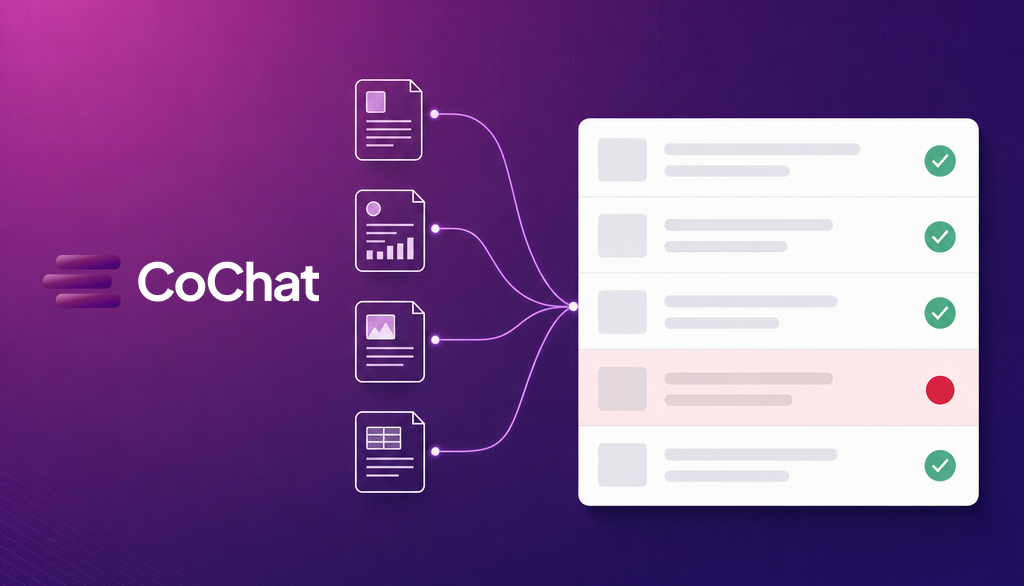
CoChat can keep this as a live literature review table while you search scholarly databases, screen results, and verify metadata. The researcher remains the author and verifier. The workspace handles the repetitive sorting and formatting.
APA format literature review example: what actually changes
An APA literature review is still organized around the review question and the evidence. APA style affects presentation and citation, not the intellectual structure. Your instructor, department, or journal may require a title page, abstract, specific heading levels, double spacing, page numbers, and an APA reference list. Check the assignment rather than assuming every review needs the same parts.
For an APA format literature review, use author-date citations for real sources and include every cited source in the reference list. Group citations when several studies support one claim. Use narrative citations when the author is part of the sentence and parenthetical citations when the claim should remain the focus.
Do not copy the placeholder labels from the example above. A real synthesis paragraph might follow this pattern:
[Shared pattern across the evidence] (Author A, Year; Author B, Year). Author C (Year) reported a different result, but that study used [methodological difference]. This difference suggests [careful interpretation], although [remaining limitation].
The phrase "literature review example APA" often leads people to focus on margins and headings first. Formatting matters, but it cannot rescue a source-by-source report. Build the synthesis, then apply the required style.
Before and after: summary versus synthesis
Before: "Author A studied immediate feedback and found better quiz scores. Author B studied delayed feedback and found better revisions. Author C studied rubric feedback and found higher performance."
This paragraph inventories three papers. It leaves the reader to figure out how the findings relate.
After: "The benefit of fast feedback appears to depend on the task. Immediate responses helped students correct discrete quiz errors in Author A (Year), while delayed or rubric-based comments supported more substantial revision in Author B (Year) and Author C (Year). Because the studies used different tasks and measures, the results suggest a boundary condition rather than a direct contradiction."
The second version makes one claim, supports it with several sources, and explains why the studies differ. That is synthesis.
A literature review template you can reuse
Copy this outline into a document and replace the brackets:
- Introduction: [Define the problem.] [State the review question.] [Set inclusion and exclusion boundaries.] [Name the organizing principle.]
- Theme or method 1: [State the shared finding.] [Compare supporting studies.] [Explain the strongest limitation or disagreement.] [State what remains unresolved.]
- Theme or method 2: [Repeat the synthesis pattern.]
- Theme or method 3: [Repeat only if the evidence supports a distinct section.]
- Cross-theme analysis: [Explain how methods, samples, contexts, or definitions account for patterns across sections.]
- Gap: [Name the exact question, population, context, or methodological problem the literature has not resolved.]
- Conclusion: [Answer the review question at the level of certainty the evidence supports.] [State the next useful research step.]
If you want a full search-to-synthesis workflow, the guide to building an AI literature review covers database search, verification, review tables, and drafting.
Common mistakes that weaken a lit review
- Starting with sources instead of a question. You collect papers without a rule for deciding what belongs.
- Using one paragraph per paper. The result reads like an annotated bibliography.
- Calling any difference a contradiction. Studies may use different populations, measures, or time frames.
- Writing the gap before the synthesis. A gap is credible only after the review shows it exists.
- Letting software write the judgment. AI can extract fields and organize notes. You still decide whether studies are comparable and whether a claim is warranted.
- Skipping verification. Check every citation and every number against the source before submission.
Frequently asked questions
How long should a literature review be?
The assignment or journal decides. A course section may be a few pages, while a dissertation chapter can be much longer. Scope and source count matter more than a universal word target.
Can I use this lit review example in my paper?
Use the structure, not the prose. The example contains fictional placeholders and cannot support a real claim. Replace it with verified sources from your field.
Does a literature review need a thesis?
It needs a clear purpose and organizing claim. A standalone review may make an argument about the state of evidence. An embedded review usually builds the rationale for the study that follows.
How many sources should a lit review include?
There is no fixed number across assignments or disciplines. Include enough high-quality sources to represent the relevant evidence within your stated scope, then follow any minimum set by your instructor or journal.
Can AI write a literature review?
AI can search, extract structured notes, build a matrix, and test an outline. It should not choose evidence or make unchecked claims for you. Treat it as research support, not as the author.
Turn the example into your own review
The useful part of a sample literature review is not its topic. It is the sequence of decisions: narrow the question, compare evidence in a shared structure, draft around patterns, explain boundaries, and name only the gap the evidence supports.
Try CoChat to search scholarly databases, organize sources in a literature review table, verify citations, and keep every claim connected to the evidence you checked.
