


Brainstorming with AI can help you generate ideas faster, explore new perspectives, and overcome creative blocks. But it also comes with a risk: if you let AI do all the thinking, your ideas quickly become generic.
The best brainstorming sessions don’t replace human creativity. They amplify it.
Whether you’re planning a marketing campaign, outlining a research project, developing a new product, or solving a difficult problem, AI works best as a creative collaborator, not the final decision-maker.
In this guide, you’ll learn practical ways to brainstorm with AI while keeping your own expertise, judgment, and originality at the center of the process.
Why AI Is Good at Brainstorming (and Where It Falls Short)
AI excels at:
- Generating lots of possibilities quickly
- Looking at problems from multiple perspectives
- Breaking through creative blocks
- Suggesting angles you may not have considered
- Organizing scattered ideas into themes
But AI struggles with:
- Understanding organizational context
- Knowing your audience deeply
- Prioritizing ideas that fit your goals
- Recognizing emotional nuance
- Making strategic decisions
That’s why the strongest brainstorming sessions combine AI’s speed with human judgment.
Eight Ways to Brainstorm with AI More Effectively
1. Start with the problem, not the solution
Instead of asking:
“Give me marketing ideas.”
Try:
“Customers abandon our onboarding after the second step. What might be causing that?”
Specific problems produce much better ideas.
2. Ask AI to challenge your assumptions
Rather than asking for agreement, invite disagreement.
Examples:
- What am I overlooking?
- What would someone argue against this idea?
- What assumptions am I making?
- What would make this fail?
Great brainstorming isn’t about confirmation. It’s about exploration.
3. Explore multiple perspectives
One of AI’s biggest strengths is perspective shifting.
Ask it to think like:
- a customer
- a researcher
- a skeptical executive
- a teacher
- a competitor
- a first-time user
Each viewpoint uncovers different opportunities.
4. Generate options before evaluating them
Many teams evaluate ideas too early.
Separate brainstorming into two phases:
Phase 1: Generate as many ideas as possible.
Phase 2: Critique and prioritize.
Keeping these stages separate leads to more creative outcomes.
5. Use multiple AI models instead of one
Different AI models have different strengths. One may produce more creative ideas. Another may be stronger at analysis. Another may challenge assumptions more effectively.
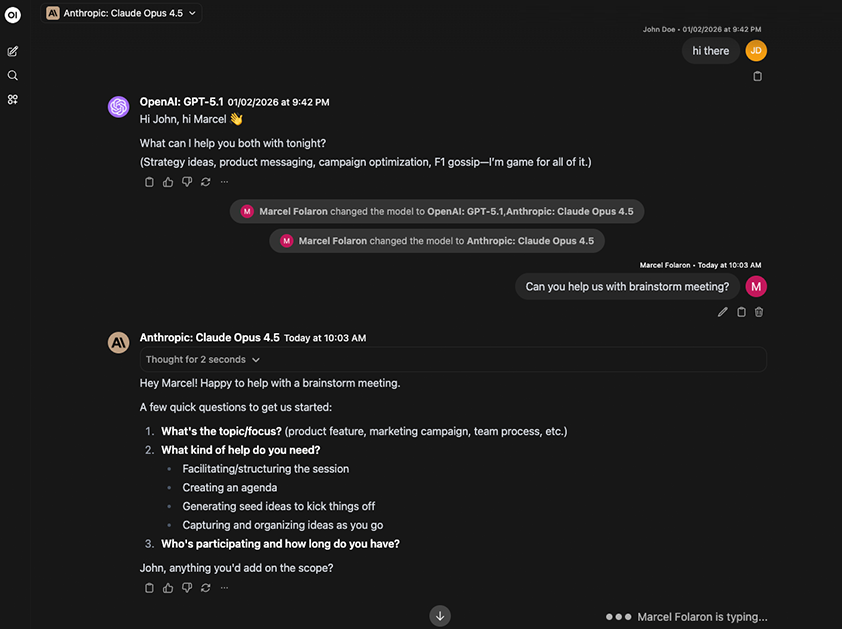
Comparing responses across more than one model instead of relying on a single AI often leads to richer brainstorming sessions.
This is one area where collaborative AI platforms like CoChat can help. Instead of relying on a single assistant, multiple AI models can contribute different perspectives while your team stays in control of the conversation.
6. Ask AI to organize, not decide
Once ideas start piling up, AI becomes especially valuable for:
- grouping similar concepts
- identifying recurring themes
- highlighting trade-offs
- creating action plans
- summarizing long discussions
Organization is often where AI delivers the biggest productivity gains.
7. Verify promising ideas
Not every AI-generated idea is accurate.
Before moving forward:
- check supporting evidence
- verify statistics
- confirm citations
- validate assumptions
Creative thinking is valuable, but reliable thinking is even more important.
This is where CoChat’s verification tools fit in. When an idea leans on a statistic or a citation, CoChat can check it against sources like CrossRef and Semantic Scholar, so you build on facts instead of confident guesses.
8. Keep humans in charge of the final decision
The best brainstorming sessions don’t end with AI. They end with people.
AI can surface possibilities. Humans decide which ideas align with their goals, values, customers, and strategy.
That’s where real creativity still lives.
Common Mistakes When Brainstorming with AI
- Accepting the first answer
- Using vague prompts
- Never asking follow-up questions
- Brainstorming with only one AI model
- Skipping fact-checking
- Letting AI make strategic decisions
Frequently Asked Questions
Can AI replace brainstorming?
No. AI is excellent at generating possibilities, but human judgment is still essential for evaluating ideas and making strategic decisions.
What’s the best AI for brainstorming?
The best approach often combines multiple AI models because different models excel at different kinds of thinking. Comparing responses usually produces stronger ideas than relying on a single assistant.
Is AI brainstorming good for teams?
Yes. AI can help teams generate ideas, organize discussions, and explore multiple perspectives. The most effective workflows keep people involved throughout the process rather than treating AI as the final authority.
Final Thoughts
Brainstorming with AI isn’t about outsourcing creativity. It’s about expanding it.
The strongest ideas come from combining AI’s speed and breadth with human experience, curiosity, and judgment. When AI becomes a collaborative thinking partner instead of a replacement, brainstorming sessions become faster, more productive, and often more innovative.
Brainstorm with More Than One AI
CoChat brings multiple AI models into one shared workspace, so your team can compare perspectives, organize scattered ideas, and keep humans in charge of the final decision. When an idea rests on a statistic or a citation, CoChat checks it against real sources before you build on it.
