Ask a chatbot for sources and one of two things usually happens. Either it hands you a beautifully formatted citation for a paper that doesn’t exist, or it hands you real papers and no way to keep track of them. Twenty tabs later you can’t remember which study said what, whether the AI’s summary was faithful, or why you saved half of them.
We built CoChat’s research workflow around a simple observation: finding sources with AI is only useful if verification happens in the same place. This guide explains why the fabrication problem exists, how to work around it, and where the tooling has actually gotten good.
Why AI makes up citations
Language models don’t look things up. They produce text that resembles everything they’ve read, and academic citations are among the easiest text to fake convincingly: real journal names, plausible author surnames, a DOI with exactly the right shape. The model isn’t lying, exactly. It’s doing what it always does — continuing a pattern — and the pattern happens to look like scholarship.
You see the same failure shapes over and over in audits of AI-assisted writing. Two real researchers who never co-published, listed as co-authors. A DOI that resolves to a completely different paper. And the sneakiest version: a real paper cited for something it never says. That last one gets past most spot checks, because the citation itself verifies fine.
Retrieval helps but doesn’t close the gap. A tool that genuinely searches an index can still misattribute a claim in the summary it writes afterwards, because the summary is still generated text. So the fix was never going to be “wait for a better model.” You generate, then you check the result against something that can’t hallucinate. CrossRef, Semantic Scholar, and DataCite exist to answer exactly one kind of question: is this paper real, who wrote it, where does it live.
What verification looks like when it’s built in
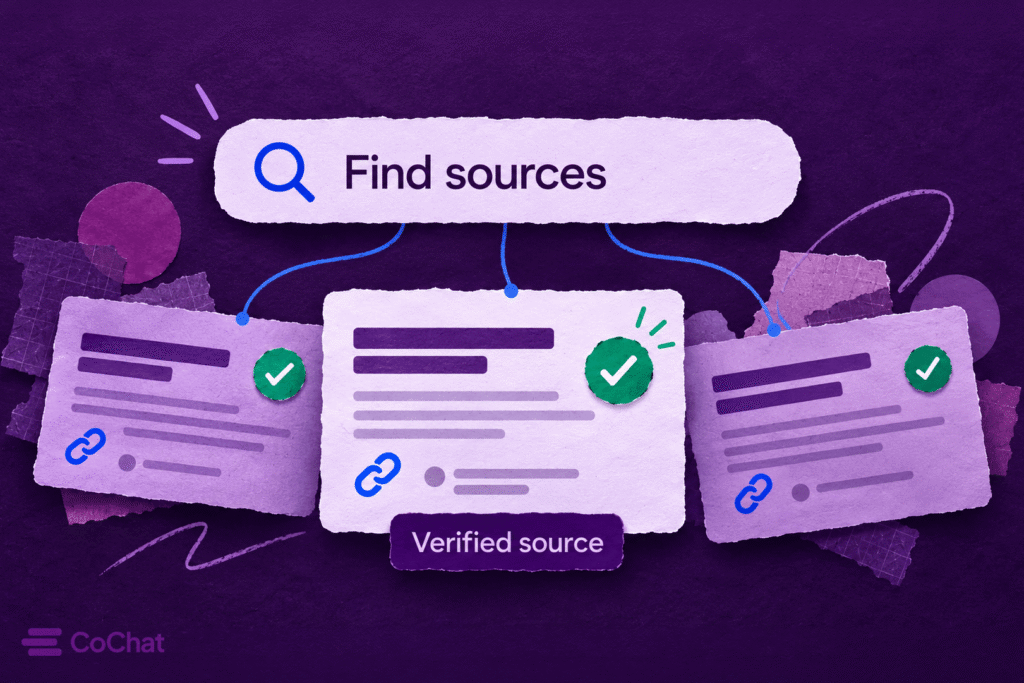
In CoChat, every source an answer cites gets checked automatically against CrossRef and Semantic Scholar, with DataCite covering arXiv and other preprints. Each citation lands in the chat’s registry with a verdict attached:
- Verified — the paper exists and the metadata matches the registry record.
- Verified with note — real paper, but something’s off. Wrong year, an author-list discrepancy, a retraction trail worth knowing about.
- Disputed — the metadata conflicts with the authoritative record badly enough to check before citing.
- Not found — no registry has ever heard of it. This is your fabrication flag, and it fires before the reference reaches your bibliography rather than after a reviewer finds it.
The registry stays attached to the conversation. Come back a week later, branch into a tangent, ask a follow-up — the sources and their verdicts are still there.
A workflow that holds up
Start from your actual question
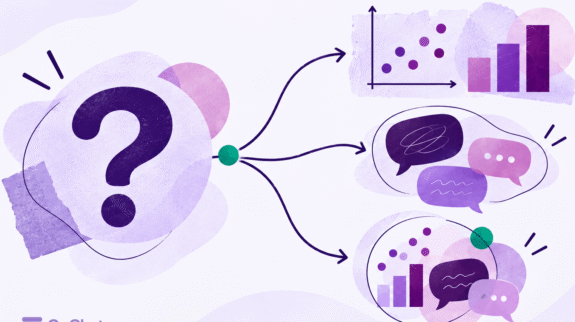
Years of keyword search trained us all to write like databases. Skip that. “What does the evidence say about spaced repetition for undergraduate STEM retention?” works better than “spaced repetition STEM” because deep search decomposes the question, fans out across scholarly indexes and the open web in parallel, and shows you which parts of the question came back well-covered and which came back thin. That last part matters more than people expect. Knowing where the literature is sparse is a finding.
Make every claim carry its source
As the answer is written, each claim cites as it goes and each source is registered and queued for verification. No separate bibliography step. You accumulate one as a side effect of asking questions.
Read the verdicts first
Before reading any paper, scan the registry. A Not found needs immediate attention. A Disputed costs you two minutes. A clean column of green means your time goes into the science.
Argue with the papers
Collecting sources isn’t research; interrogating them is. Ask how two studies’ methods differ, where the effect sizes disagree, which populations got excluded. Since the sources stay attached to the conversation, the answers come from the papers you gathered — not from the model’s general vibes about the field — and stay checkable.
Verify claims, not just citations
Here’s the part most tools skip. A citation registry proves the paper exists. It can’t prove the paper supports the sentence it’s stapled to, and claim-source mismatch is quieter and more common than outright fabrication. CoChat runs a verification pass after the answer is written, rechecking statements against their attached sources and flagging the ones a cited paper doesn’t back up. Reviewers check this. Your tools should too.
Export, or keep going
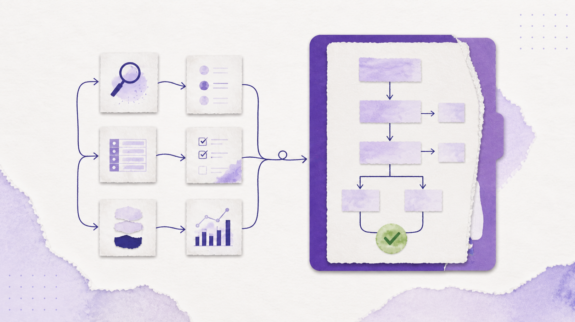
BibTeX and RIS export cover the Zotero/Mendeley/Paperpile handoff. Or stay put and grow the set into a literature review table with your own columns per study — population, method, effect size, limitations — where every row keeps its verification badge. Systematic reviewers can generate PRISMA 2020 flow diagrams from the same pipeline.
The honest tool landscape
Nobody owns this space yet, and the right pick depends on which half of the problem hurts you more. Google Scholar is still the broadest free index, and still just an index: no synthesis, no verification, no memory of your project. (We wrote up the alternatives in depth.) Semantic Scholar brings cleaner metadata and a genuinely good API. Elicit is strong at turning search into structured tables. Consensus answers yes/no questions from the literature. scite shows citation context — whether later papers support or dispute a claim — which nothing else quite does.
CoChat’s bet is the combination: discovery, conversation, claim-level verification, and structured outputs in one workflow, on whichever frontier model fits the task. If you’re actively choosing, our comparison of AI research tools goes feature by feature and says plainly where competitors win.
Spotting a fabricated citation by hand
No tooling required for a first pass. Most fabrications fall to one of these checks:
- Paste the DOI into doi.org. No resolution, or resolution to a different paper, ends the conversation.
- Check whether the authors have ever published together. Fabrications love pairing two real, famous names.
- Be suspicious of titles that restate your question verbatim. They were probably generated from it.
- Check the volume and page numbers against the journal’s actual archive.
- Search two indexes. A real paper shows up in CrossRef, Semantic Scholar, Google Scholar, or PubMed. Missing from all four is a verdict.
Common questions
Can ChatGPT find real sources?
When it actually searches, sometimes. Without retrieval it generates citations from patterns, which is where the fabrications come from. Either way it won’t verify references against scholarly registries or keep an auditable trail across your project, so treat an unverified AI citation as a lead, not a source.
What’s the best free way to find sources with AI?
CoChat’s free tier includes deep search and automatic citation verification with a daily allowance — enough for a real reading session. Google Scholar and Semantic Scholar stay free and reliable for manual work; the AI layer is what turns searching into finding.
How do I verify a citation an AI gave me?
Resolve the DOI at doi.org, then confirm the metadata in CrossRef or Semantic Scholar. Doing this more than a few times a week? Automate it — the citation checker runs that exact check on every source in every answer.
Can AI handle sources for a systematic review?
Yes, if you keep the discipline reviewers will ask you to defend: transparent search coverage, deduplication, an auditable screening trail. That’s why the deep search pipeline feeds literature-review tables and PRISMA diagrams instead of stopping at a chat answer.
Finding sources with AI stops being a gamble once verification is built in. Try CoChat free — every citation checked against CrossRef, Semantic Scholar, and DataCite before it gets anywhere near your bibliography.